Born on May 7th in 1861, Rabindranath Tagore was an integral part of the Bengal Renaissance, shaping Bengali and, by extension, Indian literature, music, and art. His work was largely associated with Modernism in Indian literature, and he became the first non-European to win the Nobel Prize in Literature in 1913. He wrote his first poem at eight-years-old, and grew to become a critic of nationalism. He also advocated extensively for India’s independence from the British Raj and wrote the Indian National Anthem. His contribution and relevance in the Indian context have been significant and undeniable, but he also earned high regard in China for his literary and academic ideas.
After winning the Nobel Prize in Literature, Rabindranath Tagore’s work caught the attention of Chinese scholars, who then began to translate his work. Chen Duxiu, who co-founded the Communist Party of China (CPC), was one of the first Chinese scholars to translate his work in 1915. Two years after Tagore received the Nobel Prize, Chen translated Tagore’s famous Gitanjali, following which other scholars such as Zheng Zhenduo, Zhao Jingshen, and Wang Duqing, among others, began to publish translations of his work as well. Once Chinese youth, academics, and scholars began to read his work, he left a profound and significant impact on Chinese literature.
Tagore’s influence in China was heightened before his 1924 visit to Shanghai and was popularly referred to as the “Tagore Wave” or “Tagore Fever.” This came at a time when Chinese intellectuals were actively looking for new ways to think about modernity beyond Western frameworks. The period between the two World Wars saw a growing interest in Asia as a shared cultural space, imagined as offering a more ethical and spiritual alternative to Western materialism. It was within this atmosphere that Tagore’s ideas of an “Eastern sensibility” began to resonate. A special issue on Tagore in Xiaoshuo yuebao (Fiction Monthly), published even before his arrival, and the poetry written around that time show that his ideas were already influencing Chinese literary circles.
Many of China’s greatest writers, lyricists, and artists are known to have taken inspiration from Tagore’s work. Guo Moruo, for example, one of China’s leading writers in the 20th century and the former President of the University of Science and Technology of China, regarded Tagore as his idol and would imitate his style of poetry and writing in his own work. He read translations of Tagore’s work while on a trip to Japan, creating in him a desperate need to write poetry. Similarly, during the progressivist New Culture Movement in China, which promoted “modern and progressive” ideas of elections and science, Xie Bingxin wrote Farewell to the Indian poet Rabindranath Tagore as a tribute to him.
Tagore’s Shanghai Visit
During his visit, Xu Zhimo, who founded the Crescent Moon Society in China, named after Tagore’s poem The Crescent Moon, acted as his interpreter. This visit was incredibly significant in building India-China relationships, and Rabindranath Tagore has often been referred to as “the bridge of India-China friendship”. On his birthday, while in China, Liang Qichao, the Former Minister of Justice of the Republic of China, gifted Tagore a Chinese name, Zhu Zhendan.
Rabindranath Tagore In China

Source: The Telegraph
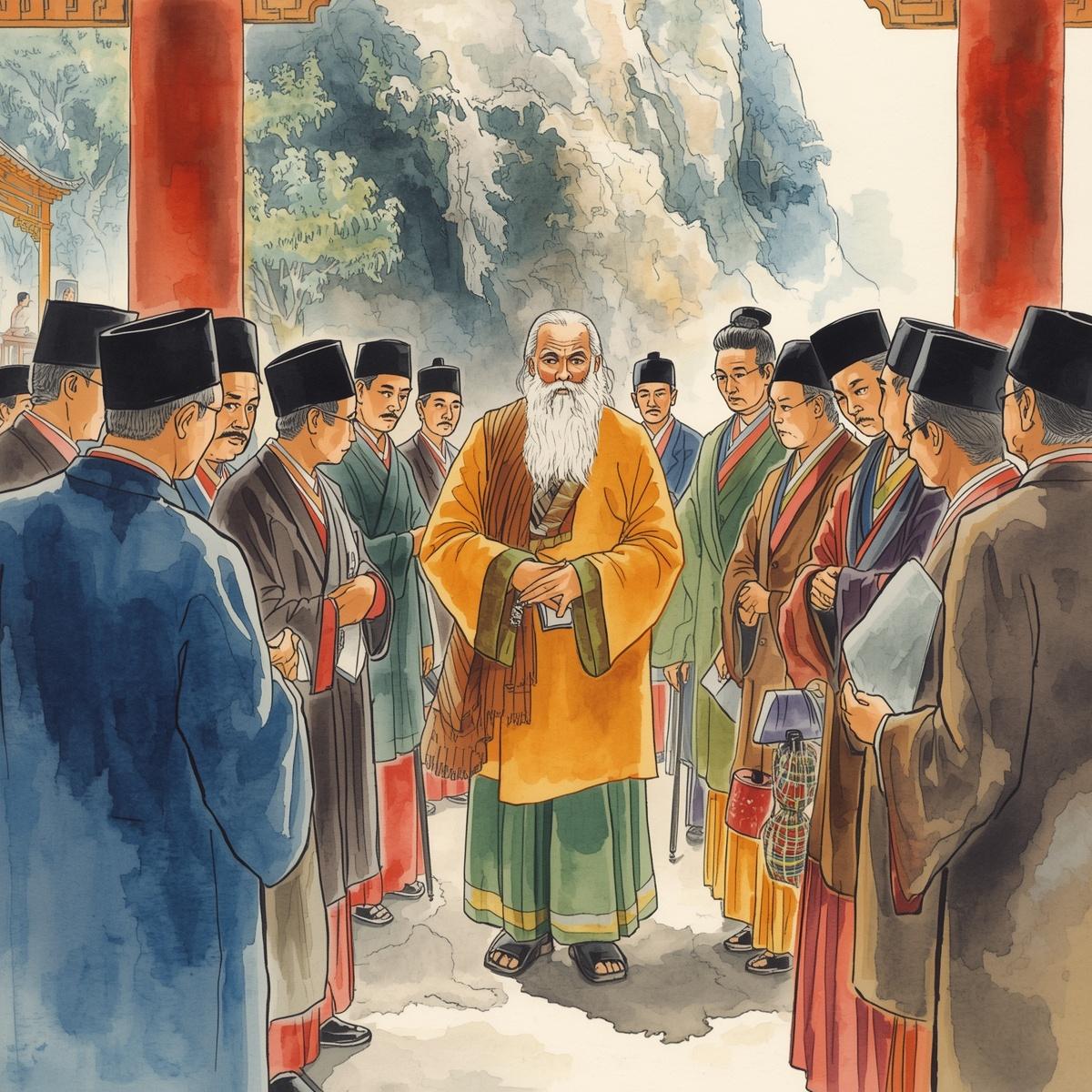
In his lectures in China, Tagore pushed back against the idea that modernity required an unquestioning embrace of the West, arguing instead that true modernity lay in a deeper “revelation of spirit in man.” This perspective resonated with some Chinese intellectuals, who saw in Tagore an alternative way of thinking about progress. He was warmly received by figures such as Liang Qichao, who drew parallels between Tagore’s visit and the journeys of ancient travellers between India and China. Liang emphasised that the two civilisations had deep historical connections, most notably through the spread of Buddhism, and that colonialism had disrupted these exchanges. He also viewed Tagore's visit as a revival of an older, more organic civilisational connection.
Mixed Reactions in Chinese Academia
At the same time, the response to Tagore was far from uniform. Writers like Bing Xin, for instance, described discovering Tagore as akin to “finding a hidden orchid while strolling along a mountain path.” Others, however, remained critical and unconvinced by his philosophy. Chen Duxiu, although one of the first to translate his work, was also critical of Tagore’s views on Western thought, nationalism and spirituality. Guo Moruo, who had once admired him, later expressed disappointment during Tagore’s 1924 visit. Additionally, Lu Xun, one of the most influential voices in modern Chinese literature, questioned the enthusiastic reception Tagore initially received. These reactions reflected a deeper unease among Chinese intellectuals of the time. In the 1920s, China was going through a period of uncertainty, trying to redefine its future after years of foreign intervention and political setbacks, including the Opium Wars, the Sino-Japanese War of 1894-95 and the outcomes of the Treaty of Versailles. For many thinkers associated with the May Fourth Movement, the focus was on building a stronger, more modern nation capable of standing up to external pressures. In that moment, Tagore’s emphasis on spirituality and his critique of nationalism felt distant from the urgent realities of an emerging nation.
Impact
Regardless of the controversies surrounding it, Tagore’s visit to China encouraged further literary exchanges between the two countries, with Indian and Chinese scholars continuing to deepen their cultural engagement by undertaking regular visits and exchanges. China’s appreciation for Tagore was reciprocated, and he even cited verses from Dao De Jing, by the philosopher Lao Zi, in his published volume of lectures titled Civilisation and Progress. Much later in his life, at age 80, Tagore wrote an untitled poem about this unusual birthday celebration. He was also said to have admired the solidarity among Chinese youth and to have been deeply appreciative of Chinese literature. He also established Cheena-Bhavana, driven by his desire to create a school focused on Chinese language, culture, and Indo-Chinese relations.
Tagore and Scholar Tan Yunshan, a teacher at Vishva-Bharati University

Source: The Hindu
With respect to Chinese academia, there has been a tremendous amount of literature and research on Tagore, both independently and as a symbol of India-China relations. Tagore's writing is still an important part of Chinese academic life. His writing continues to hold an important place in Chinese academic and literary life. His works, particularly Gitanjali and Stray Birds, have also circulated widely in China through multiple translations and editions and are commonly included in educational and literary reading lists.
Soft power and cultural initiatives have recently revived Tagore's relevance. Academic institutions and cultural bodies in both countries regularly organise events to commemorate his birth anniversary or his trip to China. In 2024, India and China marked 100 years since his 1924 visit with a range of commemorative events, reflecting on the importance of that moment in their shared history. Schools, universities, and cultural institutions celebrated his 164th birth anniversary in 2025 through seminars, performances, and discussions. The Indian Consulate in Shanghai, along with local cultural groups like Shanghai Adda, organised one such event at the Vivekananda Culture Centre. It brought together scholars, students and members of Chinese cultural and academic communities. Many participants noted that Tagore’s work still speaks to younger audiences in China today and that his ideas continue to offer a meaningful way for people in both countries to engage with each other.
In 2016, to mark the 155th anniversary of his birth, China’s People’s Publishing House undertook a major literary project to publish The Complete Works of Tagore, representing the first direct translation of his entire body of work from Bengali into Chinese. The project, which took nearly six years to complete, is significant not only for its scale but also for its emphasis on linguistic and cultural authenticity, moving beyond earlier translations that often relied on intermediary languages such as English. These newer translations have made his work more accessible to contemporary Chinese audiences, allowing for renewed engagement beyond traditional literary circles.
During a 2025 visit to Visva-Bharati University, China’s ambassador to India, Xu Feihong, highlighted Tagore’s historical role in fostering intellectual and cultural ties between the two countries. He also called for carrying forward this legacy to deepen contemporary exchanges. He visited Cheena Bhavana and credited its success to the efforts of Tagore and Chinese scholar Tan Yunshan. Emphasising the importance of educational and cultural institutions, he encouraged students to actively contribute to Sino-Indian connections, stating that “such bonds deserve to be cherished and passed on."
Chinese Ambassador Xu Feihong at Cheena Bhavan

Source: China Daily
Rabindranath Tagore has played an important role in shaping the way the two civilisations have understood and engaged with each other over time. His interactions with Chinese scholars, youth, political figures and artists opened spaces for dialogue that extended beyond his lifetime. His efforts, therefore, continue to help build a deeper sense of connection and mutual understanding between India and China.