
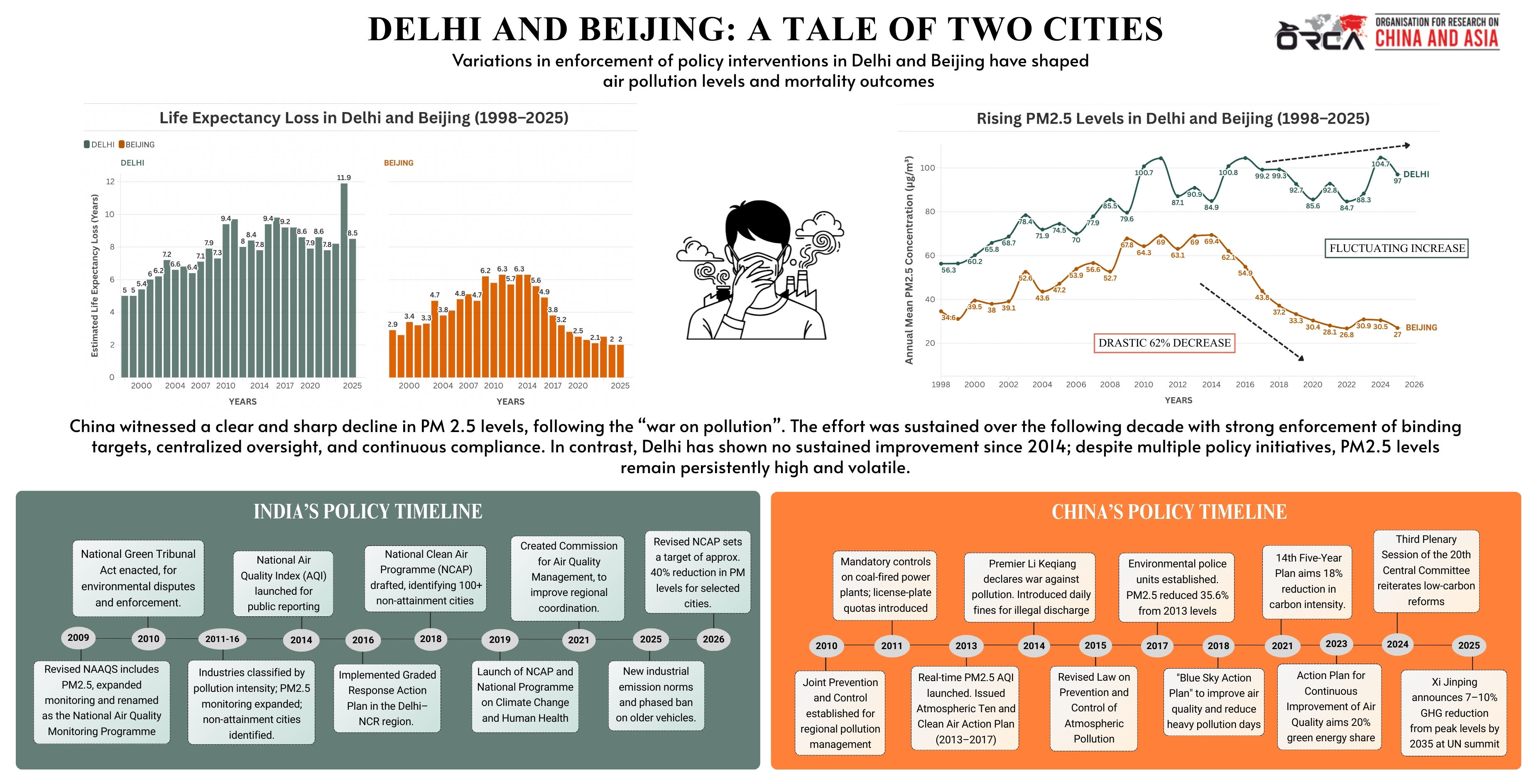

A comparison of policy initiatives and outcomes to tackle air pollution in New Delhi and Beijing reveals how similar pollution burdens and policy initiatives can produce starkly different outcomes. While Delhi has experienced persistently high PM 2.5 levels over decades, Beijing’s pollution peaked and then declined sharply following a decisive policy shift after 2014. The comparison highlights that durable air quality improvements depend less on the number of policies adopted and more on enforcement strength, policy coherence, and long-term political commitment.
These differences reflect China’s coordinated “war on pollution,” backed by binding targets, strong penalties under legal reforms, and integration of air quality goals into national planning frameworks. The continuous monitoring, centralized oversight, and accountability emphasised by policy initiatives translated into sustained compliance, instead of short-term fixes. On the other hand, Delhi’s response has taken the shape of various institutional and policy efforts, such as the National Green Tribunal, Graded Response Action Plan, and National Clean Air Programme. However, the implementation remains fragmented across agencies and levels of government, and absence of consistent enforcement has left PM 2.5 levels high and volatile. The variation in execution is also expressed in terms of the human cost of air pollution, measured as loss of life expectancy.
Sources:
-EvidenceGlide. "Evolution of Air Pollution Control Policies in India." 2024
-TERI "Air Pollution in India: Major Issues and Challenges." 2021
-Urban Emissions. "A Timeline of Air Quality Regulation in India." 2019
-Energy Policy Institute at the University of Chicago (EPIC), Air Quality Life Index (AQLI) — China & India, AQLI
-Jin, Andersson, and Zhang, "Air Pollution Control Policies in China," 2016
-Li et al., "Evolution and Control of Air Pollution in China," 2024
-Saikawa and Li, "Post-Pandemic Transformations," 2025
-UN Environment, A Review of 20 Years’ Air Pollution Control in Beijing, 2019
Prepared by
Stuti Agarwal
Stuti Agarwal is a Research Intern at the Organisation for Research on China and Asia (ORCA). She is a final-year Business Analytics student with a minor in Public Policy at FLAME University. Her work involves supporting research through data collection, analysis, and visualization. She has previously worked with labour and wage datasets in a market research setting. Stuti’s academic interests include environmental policy, sustainability, and the role of data in policy research. She is interested in using clear and accessible visuals to aid research communication and interpretation.