
The Chinese New Year reunites family members around the table for the year’s most significant dinner. With food at the centre of this occasion, the significance of releasing the No. 1 Central Document (中央一号文件) just two weeks before the Spring festival is unmistakeable. As the first policy document released by the central government every year, it sets new directions for rural development and food security policy. Moreover, the No. 1 Central Document is the first policy document released during China’s 15th Five Year Plan (FYP) period (2026-2030). Its contents and scope, dealing with food security and rural revitalization, relate to the people-centered dimension of Xi Jinping’s self-reliance (自力更生) agenda, and China’s ambition of emerging as an agricultural powerhouse.
The significance of the document’s release is further accentuated by its place in the policy calendar. Titled “Opinions of the CPC Central Committee and the State Council on Anchoring Agricultural and Rural Modernization and Solidly Advancing the Comprehensive Revitalization of Rural Areas” (中共中央 国务院关于锚定农业农村现代化 扎实推进乡村全面振兴的意见), it was released on February 3rd, a month before the Two Sessions in March, in the midst of provincial governments releasing their government work reports (GWRs). Adorned with symbolic significance, the No. 1 Central Document details the Party and State’s codification of new trajectories in 2026 and departures from 2025, the first step of China’s 15th FYP.
Food Security and Stability
China’s first policy announcement of the year pushes for food security through stability in agricultural output. The first section of the document engages with the question of grain and oil crop production, explicitly calling for grain output to be stabilized at 700 million tons. Although China’s 2025 Government Work Report (GWR) does mention a specific target for grain output, it is noteworthy that the 2025 version of the No.1 Central Document did not specify any target. It speaks to the importance of making grain output an explicit target of agricultural production in 2026. More importantly, the 2026 version offers a revised, more comprehensive outlook on the subject of agricultural output, by emphasising a simultaneous focus on output and capacity, production and ecology, and increased yields and income (产量产能、生产生态、增产增收一起抓). According to Huang Zuhui, of the China Rural Development Institute at Zhejiang University, this is a multi-dimensional framework for food security. While it sets a concrete target, the approach to agricultural output is holistic, going beyond just increases in output. This new approach to output in agriculture mirrors the policy rhetoric of “high-quality development” typically observed in relation to manufacturing sectors where China is shifting the emphasis from output to quality, value, productivity and efficiency. For example, in the 2025 No.1 Central Document, China called for large-scale increase of yield, but in 2026, it specified “in terms of per unit area for grain and oil crops” (推进粮油作物大面积提单产), thus emphasising greater per unit productivity rather than just yield increases.
China’s food security strategy also accords greater importance to the “food basket” (菜篮子), compared to 2025. Ranked second in the order of measures in the document (up from seventh in 2025), it signals greater emphasis on the simultaneous development of agriculture, forestry, animal husbandry and fisheries. The primacy of agricultural productivity and a diversified food supply system reflect an interest in controlling food prices and inflation, thus strengthening economic and social stability.
China’s food security strategy is also executed by pursuing diversification. The No. 1 central document for 2026 differs from the previous version by mentioning improvements in grain varieties, as well as diversifying the supply of oilseeds. It dovetails with the outcomes of the Central Rural Work Conference held in December 2025, where policymakers pledged to “enhance the capacity for diversified food supply”. Moreover, the first section of the 2026 document calls for promoting the diversification of agricultural imports (推进农产品进口多元化), which was missing in 2025. Responding to trade protectionism of the US administration and external disruptions to global food supply chains like the Russia-Ukraine war, China is moving to mitigate shocks to food security by pursuing further import diversification.
Food security is also addressed by considering factors of production, mainly land. First, China plans to conduct more province-wide pilot programs to extend land contracts for another 30 years as contract expiries peak between 2026 and 2028. The renewals will maintain stability of originally contracted land of farmers. Second, farmland protection has received much greater emphasis than in 2025, indicating China’s interest in maximising domestic agricultural production capacities. The 2026 No. 1 Central document calls for the formulation of special plans for farmland protection (制定耕地保护专项规划), mentioning protection of topsoil, soil improvement and soil fertility enhancement, and targeting illegal occupation of farmland for housing construction. Agricultural disasters, a threat to food security, are also treated more comprehensively in the latest policy document. The Party-State has called for an improvement in the ability to cope with extreme weather through a survey of agricultural climate resources. More importantly, the document goes further than its earlier version which did not discuss droughts, by calling for construction of drought-relief emergency water source projects (加强抗旱应急水源工程). This is likely because 2025 was the hottest year in China since 1961, and a persistent drought affecting vast regions of the country strained irrigation systems and heightened risks of pests, diseases, wildfires and threatened crop failures. The 2026 document also takes a consolidated view of pests and animal diseases by calling for joint prevention and control, to safeguard farmland quality and output.
Technology and Infrastructure Inputs
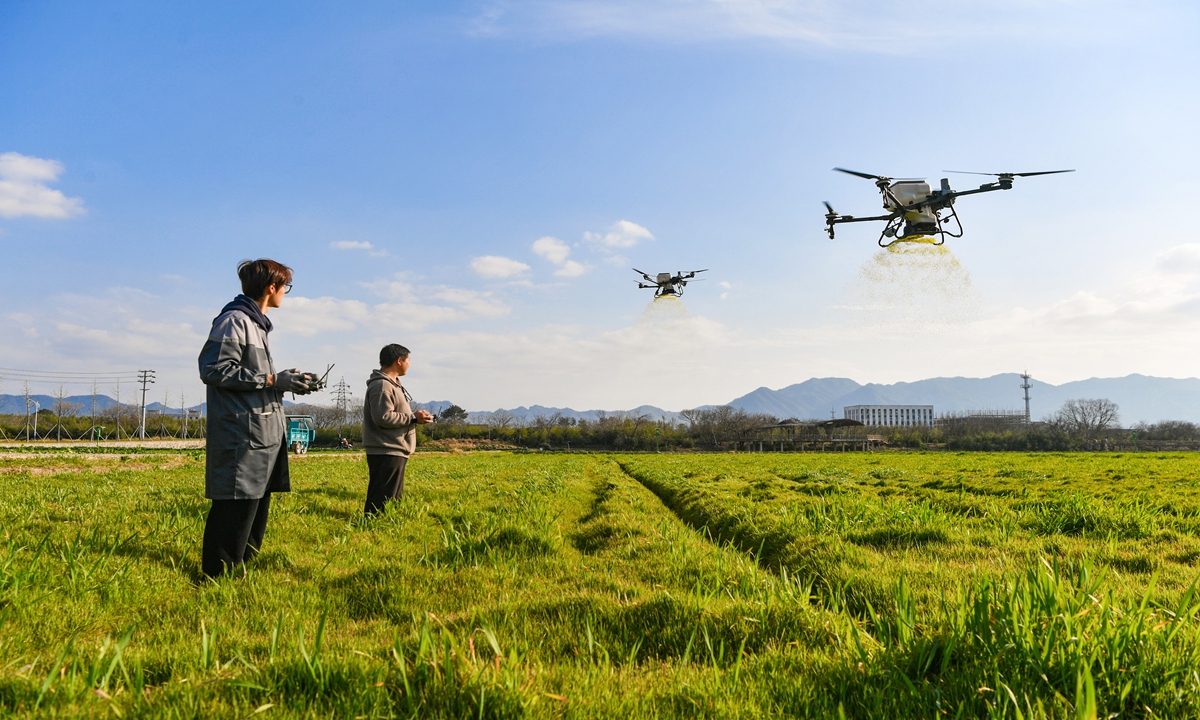
With high-quality development of China’s economy as the guiding principle, the No. 1 Central Document approaches key inputs of production in agriculture with a view to advance their integration with production processes. Technology has received significant attention in agricultural policy discourse, due to emerging limitations on the availability of rural labour. Officials are planning leaps in productivity by integrating artificial intelligence (AI), drone technology, Internet of Things (IoT), robotics and key technologies in agricultural production. The policy plan for 2026 also includes deepening reform of agricultural research institutes (深化农业科研院所改革) and agricultural college education and teaching reform (农高校教育教学改革) to take breakthroughs “into villages and households” (进村入户). It also borrows from local experiences in agricultural technology policy with the science and technology commissioner system, which originated in Nanping, Fujian, to dispatch special teams that provide targeted assistance. Other factor inputs like infrastructure have also been addressed, not only to raise productivity, but to manage a variety of broader economic and social issues in rural China.
The 2026 rural development policy plan focuses on strengthening rural infrastructure relating to water, power and transportation. Energy infrastructure in particular has been elevated in importance, with planned enhancements to rural power grid capacities and charging facilities. The focus on infrastructure is explained by the need to generate economic growth through construction of major regional and cross-regional projects in underdeveloped areas, forest areas, reclamation areas and remote regions. The policy also leverages infrastructure to promote urbanization of agricultural populations, and two-way flow of factors of production between urban and rural areas (推动城乡要素双向流动). With county-towns as key nodes, public service infrastructure emerges as a key driver of rural development in 2026. Education facilities have received greater attention this year, with a high-school revitalization action plan for county-level schools to prevent the degradation of education quality in rural areas, due to issues like poaching of teachers and poor municipal support in areas with weak educational foundations. Similarly, county-level hospitals and key central township heath centres are targeted for upgradation in 2026. However, the document does not match the comprehensive coverage of rural healthcare issues as it did in 2025.
China’s rural development policy of 2026 is also responding to the decreasing availability of rural labour by stabilising labour market mobility. Ensuring availability of abundant rural labour keeps production costs low, and reduces associated externalities like left-behind children (留守儿童) and similar social phenomenon. For instance, a notice by the Guangzhou Municipal People’s Government argues that the shortage of agricultural labour could even marginalize the application of new agricultural technologies. In this context, the 2026 document calls for creating stable employment for migrant workers, strengthening the rural talent pool and adopting more flex ible contracting methods for projects implemented by rural grassroots organizations. Productivity, which is a consistent theme across the 2026 policy plan, is reflected in China’s plan to develop high-quality human resources at the grassroots level. For instance, the cultivation of agricultural entrepreneurs (培育农创客), which is mentioned for the first time in the No 1 Central document, and is borrowed from Zhejiang’s conceptual innovation, calls for greater entrepreneurship in agriculture. By addressing the conditions influencing the quality and stability of factor inputs, China’s policy plan for rural development and agriculture has a dual purpose; to further food security and social stability.
Poverty Alleviation and Grassroots Governance
Rural development policies focused on poverty alleviation have been transformed significantly in 2026 policy plans, following the transition period after the declaration of victory in the battle against poverty in 2021. China has introduced “regular and targeted assistance” (常态化精准帮扶) for the next phase of its rural poverty alleviation policies. It is focused on improving accurate identification and monitoring of groups at risk of returning to poverty, and providing tiered assistance based on intensity and nature of factors affecting recipients recently lifted out of poverty. The new direction of poverty alleviation policy identifies improvements in the “three guarantees” (三保障), and industrial and employment assistance. A guideline by the People’s Bank of China released on 14th February confirms the support mechanism outlined in the No.1 Central document. It is likely to mean China will sustain welfare interventions, but redirect focus to at-risk social groups. One particularly important stakeholder in rural development, whose income growth has received special attention in the No 1 Central Document is farmers.
A dedicated chapter in the document on farmer incomes has detailed robust policy supports to motivate farming communities. Subsidies for agricultural machinery and minimum purchase prices have been extended to rice, wheat, cotton, corn and soybean producers. Moreover, farmer incomes will be expanded through e-commerce, tourism, digital marketing and participation in industrial cluster development. Expanding rural consumption formats has been regarded as an effective pathway to increasing farmer incomes. However, the Party-State is cautious about rapidly scaling channels of industrial development in rural areas, warning against a rush to start projects and drastic fluctuations. The watchful approach suggests a sensitivity to overcapacity, price instability and imbalanced distribution risks affecting farming communities. Predictably, it rationalises the need for stronger grassroots governance and oversight by the Party.
The 2026 policy document reflects the Party’s interest in strengthening its leadership of the grassroots level and addressing challenges to its authority and image. For instance, it calls for optimising leaderships at the village-level Party committees, prohibiting the secondment of staff from counties and townships instead of recruitment of civil servants. Moreover, the document reiterates the need to rectify work style problems and enforce the Eight-Point Regulation to handle corruption. Overall, it indicates a continuation of ant-corruption and discipline inspection work at the lowest levels of China’s administrative structure.
Takeaways
The No. 1 Central Document has made notable shifts and adjustments to China’s food security, poverty alleviation and rural development policies. The emphasis on stability derives from a combination of internal and external factors relating to tariff pressures, slowing economic growth and even issues relating to the corruption conviction of former agriculture minister, Tang Renjian. The appointment of Han Jun as Minister of Agriculture and Rural Affairs, who has a stronger educational background in agriculture than his predecessor and extensive research experience in agricultural policy, indicates delegation of responsibility to specialist leadership capable of ushering new transitions in China’s agricultural sector. Nonetheless, the broad objective of rural development policies remains consistent; to accelerate the construction of an agricultural powerhouse (加快建设农业强国). It ties into broader national interests relating to self-reliance, comprehensive national security and high-quality development.
China has adjusted its agriculture development policies to attain food security through higher productivity, import diversification and comprehensive food chain linkages. It is pushing for modernization of the rural economy by integrating emerging industries with production processes, improving public service infrastructure and addressing emerging challenges in the rural labour market. Beijing has also initiated a new phase of poverty alleviation policies, focused on raising farmer incomes and pledged to improve grassroots governance. These shifts reflect broader economic objectives to raise consumption levels, enhance urbanization patterns and institute a new development pattern characterised by higher productivity and modernization of agriculture. Although the No.1 Central Document of 2026 expects to facilitate these broader economic shifts, it remains unwavering in its fundamental guarantee of ensuring social stability in the face of emerging internal and external headwinds.
Image Source: Global Times
Author
Rahul Karan Reddy
Rahul Karan Reddy is Senior Research Associate at Organisation for Research on China and Asia (ORCA). He works on domestic Chinese politics and trade, producing data-driven research in the form of reports, dashboards and digital media. He is the author of ‘Islands on the Rocks’, a monograph on the Senkaku/Diaoyu island dispute between China and Japan. He is the creator of the India-China Trade dashboard, the Chinese Provincial Development Indicators dashboard and co-lead for the project ‘Episodes of India-China Exchanges: Modern Bridges and Resonant Connections’. He is co-convenor of ORCA’s annual conference, the Global Conference on New Sinology (GCNS) and co-editor of ORCA’s daily newsletter, Conversations in Chinese Media (CiCM). He was previously a Research Analyst at the Chennai Center for China Studies (C3S), working on China’s foreign policy and domestic politics. His work has been published in The Diplomat, 9 Dash Line, East Asia Forum, ISDP & Tokyo Review, among others. He is also the Director of ORCA Consultancy.