
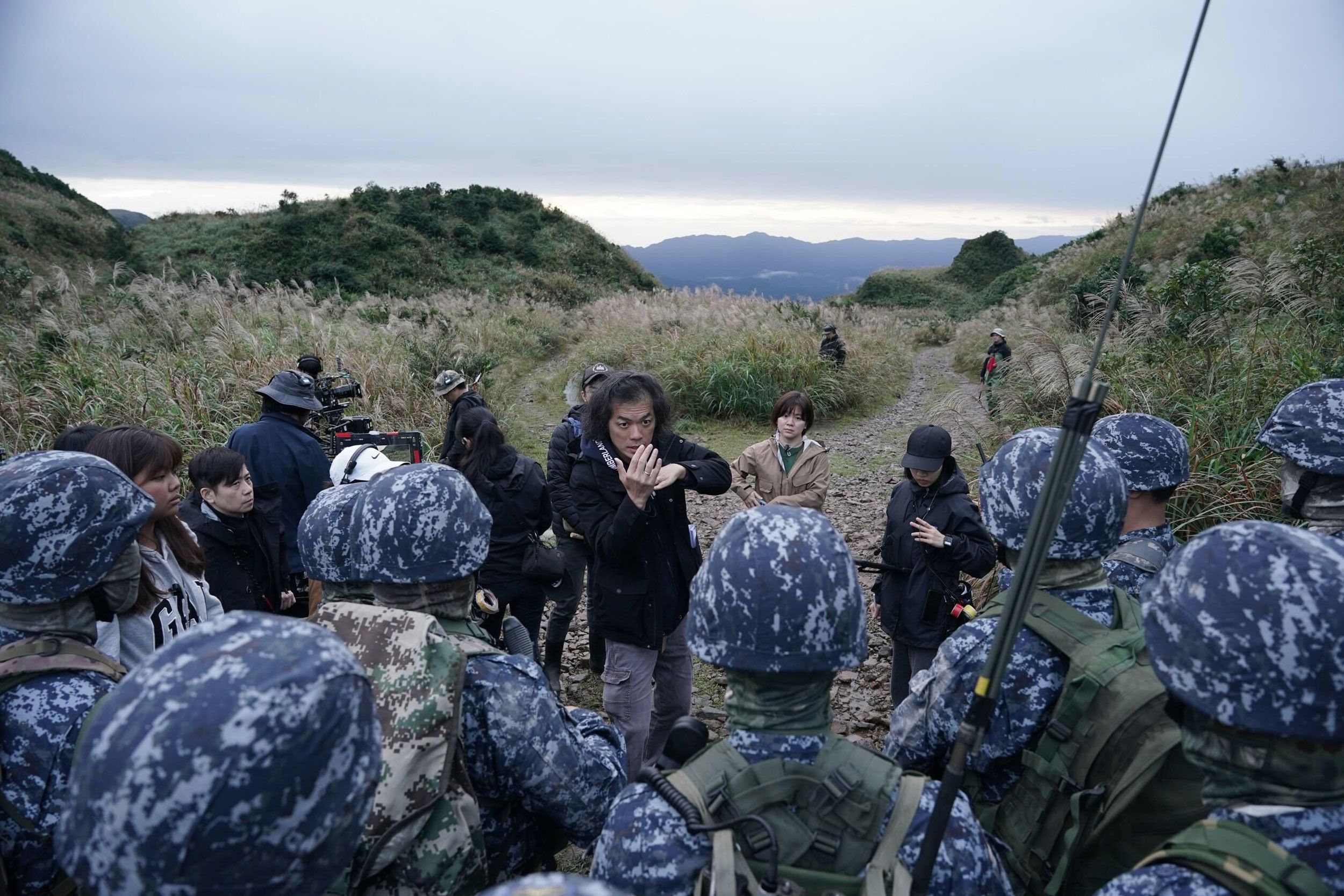
The first five episodes of the Taiwanese television drama “Zero Day Attack” (零日攻击) focus squarely on China’s subversion campaign against Taiwan, remaining closely tied to political developments and decision makers in Taipei. Episodes 6 and 7 move to the rural coastal areas of Kaohsiung Prefecture in southern Taiwan where the looming invasion fades into the background, allowing everyday concerns and local beliefs to take precedence.
Episode 6 follows a television crew interviewing Chen Si-Wei, a joss paper shop owner in the Chikan Coastal Area of Kaohsiung, in the lead-up to a ‘Prince Boat’ burning ceremony. Episode 7 adopts a more absurdist tone, centring on Bin, a small-time crook caught up in the re-election campaign of the corrupt local politician Rong, and shenanigans involving the latter’s pet pig. Both episodes are unified by a focus on Taiwanese folklore and popular religion, through which the threat of Chinese invasion is interpreted.
Converging Pressures
At the outset of both episodes, the protagonists’ motivations are strikingly immediate. In episode 6, Si-Wei’s Chinese wife, Liang Hsin, has left Taiwan and urges him to flee to the mainland, while his aging mother insists on staying. Yet war is not foremost in Si-Wei’s mind. His mother has dreamt that her deceased husband wants his bones reburied, and she asks Si-Wei to cast moon blocks to divine the gods’ will. His irritation introduces a tension between traditional ancestor worship and the more secular outlook of the younger generation. Despite his complaints, Si-Wei’s actions reveal genuine belief. He scolds his daughter Guo-Guo when he discovers partially burnt joss paper that did not come from their shop. Joss paper functions as a form of ‘spiritual currency’, burned to communicate with wandering spirits, and his reaction underscores his acceptance of this cosmology.
Episode 7 opens with Bin complaining about the rising price of betel nuts, and dreaming of starting a business in Vietnam, framing escape in economic terms. His girlfriend, Helen, is an apparently mute Vietnamese hostess, representing the vulnerability of Southeast Asian immigrant women in Taiwan and their frequent involvement in the sex industry. Pressure intensifies when Rong, the crooked local politician to whom Bin is indebted, begins to lose ground in the polls. The episode exposes the entanglement of organized crime and local politics: media figures courted in KTV bars with money and women, voters handed napkins stuffed with cash. The issues animating voters remain resolutely local- the fate of oyster farms, for example- illustrating how distant national security concerns can feel at the grassroots level. It is only when actions that corrupt local politics, such as vote buying and organized crime, are weeded out, that people can focus on big picture issues.
The parochialism of local politics is best exemplified by Bin’s resentment of Rong, which stems not from the fact that Rong is backed by China, but because he is with Helen- an arrangement she is forced into out of financial necessity. Everything about the plot is deliberately petty. The head of the fishermen’s association loses the treasury keys gambling with Rong; Rong’s pet pig swallows the key; Bin takes the pig home and sifts through its excrement to retrieve it, only for the pig to escape. The absurdity mirrors the moral smallness of the world the characters inhabit.
Microcosms of the World
While geopolitics recede from the foreground, they surface obliquely through symbolism and detail. In episode 6, temple divination produces a troubling prophecy: ‘A lonely southern bird flies to its northern nest,’ followed by a warning that ‘future generations will suffer the consequences.’ The phrasing echoes the spectre of forced unification and its long-term costs.
In episode 7, Bin and his accomplice Yu break into the fishermen’s association office wearing Donald Trump and Vladimir Putin masks. The image is absurd but pointed, reflecting Taiwan’s entanglement in great-power politics. In a brief televised moment, Rong proclaims that ‘people on both sides of the straits are family,’ illustrating how even village-level politicians can echo the language of Chinese subversion. The geopolitical struggle permeates daily life, even when it is not explicitly acknowledged.
Faith- specifically Taiwanese popular religion- becomes the lens through which these pressures are interpreted. In episode 6, Si-Wei appears possessed by the spirit of Lord Koxinga during a temple ritual. The reference to Koxinga or Zheng Chenggong, the Ming warlord who expelled the Dutch from Taiwan in 1661 but failed to reclaim the mainland from the Qing, suggests a historical cycle of conflict and foreshadows a doomed cross-straits war. In a second trance, he sets the date for the boat-burning festival- a ritual the show has modelled on the burning of the King Boat in Donggang- on the same date as his plane tickets to the mainland, almost as if divine intervention compels him to stay in Taiwan.
Episode 7 presents faith in a darker register. Bin claims that Helen is possessed by the popular goddess Mazu, and attempts to exploit the gullibility of the townspeople to get them to vote for Rong. Rong on the other hand, sincerely tries to negotiate with the divine. In bed with Helen, he invokes an incoherent pantheon- Mazu, Guanyin, Guan Gong, even Jesus Christ- promising ‘anything’ for electoral victory. Faith here becomes transactional and debased, stripped of reverence.
Diverging Consequences
The consequences of these approaches to faith diverge sharply. At the end of episode 6, Si-Wei decides not to return to the mainland, recalling how a cousin once cheated him out of a factory there. A tense night follows when Guo-Guo goes missing, only for it to emerge that she has taken shelter in an old air raid bunker. As the Prince Boat burns, its flames echo images of falling bombs. ‘We will all die if bombs are dropped now,’ Si-Wei reflects, but he also recognizes a community unified in ritual, preserving a uniquely Taiwanese tradition.
Episode 7 ends with surrealism. Rong wins the election but disappears. It is revealed that Helen is genuinely a sorceress, who transforms the corrupt villagers into pigs. Only Yu, who has enlisted in the army, is spared. The message is that while tests of spiritual and political faith are inevitable, sincerity matters. Genuine belief- both in deities and in Taiwan- offers the possibility of communal endurance. Insincerity and moral cravenness render prayer hollow and lead only to ruin. At the grassroots level, where questions of national interest ring hollow against parochialism and pettiness, faith is the first step towards something better.
Image Source: CNN
Author
Hans Deepak
Hans Deepak is a research intern at the Organisation for Research on China and Asia (ORCA). He is a second-year undergraduate at St Catherine’s College, University of Oxford, pursuing a degree in History and Politics. His interests include international relations, military history, and strategic studies, with a particular focus on China and Southeast Asia.