
The March 2026 “Two Sessions”—comprising the fourth session of the 14th National People’s Congress (NPC) and the 14th National Committee of the Chinese People’s Political Consultative Conference (CPPCC)—effectively marked the policy inauguration of China’s 15th Five-Year Plan (2026–2030). At the centre of this policy moment was the 2026 Government Work Report delivered by Premier Li Qiang to the NPC, which underscored Beijing’s intention to accelerate the pursuit of “greater self-reliance and strength in science and technology.” The emphasis placed on technological autonomy in the report signals the elevation of innovation capacity from a developmental priority to a strategic imperative within China’s next planning cycle.
This articulation did not emerge in isolation. Rather, it builds on the trajectory established earlier at the Fourth Plenary Session of the 20th Central Committee of the Chinese Communist Party (CPC) in October 2025. While the communique issued after the meeting contained few institutional surprises, it consolidated the leadership’s commitment to strengthening indigenous innovation and advancing “new quality productive forces,” priorities that were subsequently formalized in the draft framework of the 15th Five-Year Plan submitted to the NPC during the 2026 Two Sessions. In effect, the Party forum provided the ideological and strategic direction, while the state planning process translated that direction into programmatic policy.
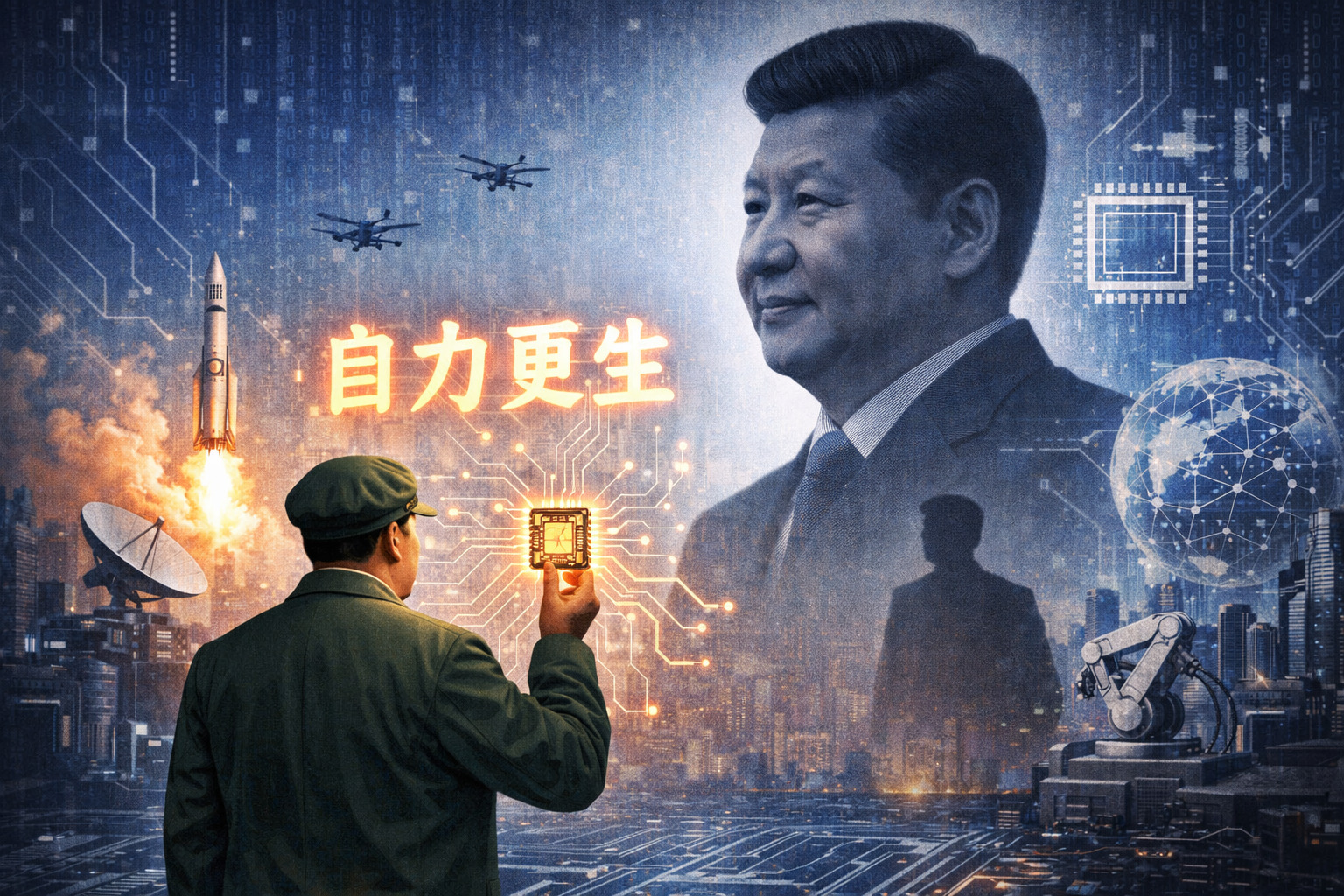
Seen together, these developments point to a renewed institutionalization of zìlì gēngshēng (自力更生), or self-reliance, as the ideological core of the country’s developmental and geopolitical trajectory for the next decade, which is most clearly visible in the technology sector. Since the Fourth Plenum, the concept has been repeatedly invoked as a guiding principle for economic restructuring, with emphasis on scientific and technological autonomy reflecting Beijing’s assessment that innovation capacity now constitutes the decisive terrain of international competition.
Under Xi Jinping, the call to self-reliance is not simply a slogan for domestic resilience. Instead, it signifies a civilizational reconfiguration of China’s interaction with the global system, one that blends Maoist self-strengthening with the logic of a modern techno-state. In this context, zìlì gēngshēng becomes analytically significant because of its conceptual elasticity. The doctrine has evolved across distinct historical phases: from wartime mobilization during the revolutionary period, to thriving during Maoist isolationism (particularly amid the Sino-Soviet split), to its partial museumification under Deng when the Party pursued reform and opening while still retaining “independence and self-reliance” as a legitimating revolutionary inheritance. Even as Deng pursued reform and opening, the language of zìlì gēngshēng remained embedded within Party discourse, as reflected in his address to the 12th National Party Congress in 1982.
Still, it is wise to caution against reading Xi’s invocations as simple Maoist revivalism. Undergoing resurgence under Xi Jinping first in 2018—especially in the context of high-tech—the concept signalled less a return to ideological closure than a technologically-driven response to China’s vulnerability in global supply chains and Western accusations of tech theft. At a functional level, the emphasis on technological self-reliance is rooted in Beijing’s growing perception of vulnerability within globalized production networks. Dependence on external suppliers for critical inputs—particularly in semiconductors, advanced manufacturing equipment, and software ecosystems—renders China susceptible to exogenous shocks such as export controls, sanctions regimes, and supply chain disruptions. In this sense, self-reliance is not merely ideological but a form of systemic risk mitigation. Simultaneously, it serves an internal economic function: by forcing domestic substitution and indigenous innovation, it aims to raise total factor productivity, deepen manufacturing competitiveness, and push Chinese firms up the value chain. Thus, zìlì gēngshēng operates at the intersection of security and development, where resilience and upgrading are mutually reinforcing rather than conceptually distinct. In this framing, zili gengsheng remains a strategic-developmental doctrine within global interdependence: not isolation, but resilience under conditions of external coercion.
A Means to Conceptualizing the Politics of the Economy
A critical mistake made in studying China’s engagement with the idea of zìlì gēngshēng is when it is treated as a mere policy preference for autarky or domestic substitution. Rather, the Mandarin formulation embeds an additional and crucial semantic layer: “regeneration through one’s own power and effort.” In other words, zili gengsheng is not just about relying on oneself, but about re-making the conditions of survival and development through disciplined struggle under constraint. This renders it a dynamic political concept rather than a static economic one. This is why translating it narrowly as “self-reliance” misses the ideological point: the Party under Xi is not merely urging domestic capability, but demanding a kind of political regeneration through constraint, a narrative that turns external pressure into an internal mandate for technological self-strengthening.
Historically, the CCP first deployed the term in the late 1930s as a tifa (提法)—a canonised Party formulation—during periods of acute material scarcity during the Long March and blockade in the Yan’an base areas. As the War of Resistance against Japan and the battle against the Nationalist forces of the Kuomintang brought pressure on two-fronts, Chairman Mao framed self-reliance explicitly as a matter of policy necessity despite the concept predating the wars. In 1945, he elevated it as an ideological posture: the Party may have “friends” in anti-imperialist struggles, but the basis must rest on regeneration through one’s own efforts. He also used emphasis on relying “entirely on our own efforts” as a means to establish CPC’s patriotism as “the very opposite of Chiang Kai-shek, who depends entirely on foreign countries”. Thus, the term accrued affective weight as a blend of political willpower, economic self-sufficiency, and spiritual discipline, becoming part of the CCP’s symbolic repertoire of survivalism and organisational resilience.
In the early post–civil war period (early 1950s), the CCP discarded the wartime self-reliance line and instead adopted the Soviet developmental model while implementing its first Five-Year Plan, becoming deeply dependent on Soviet aid and technical experts for industrialisation. Leading up to and post the Sino-Soviet split between 1958-1978, the CPC once again began revitalizing “self-reliance” as a development and foreign policy principle (see figure 1 and 2 posters below). The approach continued during the Great Leap Forward and the Cultural Revolution, when self-reliance was widely propagated but also got juxtaposed with radical revolutionary values. As a result, this time, self-reliance did not accelerate industrialisation. Instead, it fed into the ills of the Leap and furthered isolationism.


Figure 1 and 2: Cultural Revolution-era propaganda posters (1971–1973) depicting industrial and rural labour as embodiments of zìlì gēngshēng (self-reliance), highlighting mass mobilisation and ideological discipline. The imagery reflects how self-reliance became intertwined with revolutionary zeal, often at the cost of industrial efficiency.
Source: Chinese Posters, chineseposters.net (e15-628; pc-1971-007)
Under Deng Xiaoping, self-reliance was deliberately de-radicalised: it remained in Party vocabulary as a symbolic revolutionary inheritance, but in practical economic terms it was largely sidelined— Deng simultaneously prioritised reform and opening, and invoked “independence and self-reliance” largely to frame integration with the global economy as something China would pursue on its own terms. Xi Jinping, however, reactivated zìlì gēngshēng in a markedly different register: not as Mao-era isolationism or autarky, but as a strategic resilience doctrine geared toward overcoming external vulnerability in “key technologies.” Thus, as US–China trade and tech competition escalated in 2018, Xi has argued that China is “forced to take the road of self-reliance,” reframing the term as developmental regeneration under constraint rather than retreat from global interdependence.
Reading Self-Reliance under the Political Anatomy of the Fourth Plenum
Cut to 2025, and the revival of Zìlì Gēngshēng in Xi’s political lexicon has taken on a more concrete hue. No longer limited to just a tifa, this Mao-era dictum has been re-contextualized as a 21st-century project of technological and systemic autonomy. The Fourth Plenum has centralized it as an objective of the 15th Five-Year-Plan in specific connection to kējì zìlì zìqiáng (科技自立自强) — “scientific and technological self-reliance and self-strength” — an idea that situates technological sovereignty as the foundation of political sovereignty. By intertwining the concept with the goal to “steer the development of” new quality productive forces (新质生产力), it is meant to insulate China’s rise from Western containment while reasserting the Party’s primacy over market forces, innovation, and discourse power.
Contemporary Chinese academic and Party discourse frames 自力更生 (zìlì gēngshēng) not merely as an economic policy orientation but as a civilizational and ideological principle embedded within the CCP’s governing philosophy. Chinese scholarship frequently presents self-reliance as part of the Party’s broader 精神谱系 (spiritual lineage)—a historically evolving repertoire of political virtues that includes perseverance, innovation, and collective struggle. In this framing, zili gengsheng is inseparable from the ethic of 艰苦奋斗 (jiānkǔ fèndòu, “hard struggle”), together constituting a moral-political code that has guided China from revolutionary survival to contemporary development. Official discourse, therefore links the concept not only to wartime production movements such as Yan’an and Nanniwan, but also to later developmental achievements—from the “Two Bombs, One Satellite” program to present-day technological breakthroughs. In this sense, the language of self-reliance operates as a narrative of national endurance: the idea that China’s rise has been achieved by “placing national development on the foundation of its own strength” (把国家和民族发展放在自己力量的基点上) and mobilising society around disciplined collective effort.
Under Xi Jinping, this discourse has been updated to reflect the geopolitical and technological pressures facing China in the current international system. Chinese writings argue that the contemporary era of strategic competition, supply-chain vulnerability, and technological containment requires China to pursue “a higher level of self-reliance” (更高水平的自力更生)—particularly through 科技自立自强 (kējì zìlì zìqiáng), or technological self-strengthening. Yet these discussions simultaneously emphasise that self-reliance is not synonymous with economic closure. Rather, it is a strategic synthesis between domestic capability-building and continued global engagement, with high-level openness and self-reliance required to advance together to support the dual circulation (双循环) development model. In this interpretation, self-reliance functions as the strategic baseline of national security and development: an adaptive doctrine through which China seeks to ensure technological sovereignty and systemic resilience while remaining embedded in global economic networks.
What to Expect: From Policy Orientation to Structural Reordering
As shown at the Fourth Plenum in 2025 and now as a critical variable of the 15th Five-Year Plan, zìlì gēngshēng is not merely a rhetorical flourish. Officials reaffirmed that China’s “top strategic task” is to “build a modern industrial system and strengthen the foundation of the real economy,” with emerging sectors such as AI, semiconductors, quantum computing, hydrogen, and biomanufacturing prioritized as engines of new-quality productive forces.
Elevation of self-reliance as a political virtue reflects a structural anxiety: Beijing no longer assumes access to global technologies, supply chains, or financial flows as guaranteed. Zìlì gēngshēng thus functions both as a hedge against containment and a tool of ideological legitimation — an assertion that China’s rise is self-sustained and historically inevitable. Cementing China’s trajectory towards state-managed technological nationalism, self-reliance will translate into an acceleration of investments in computing infrastructure, AI, robotics and quantum technology. The Party will orchestrate innovation through national new-quality laboratories and state-guided industrial clusters, merging central planning with venture capital incentives. This model, while effective for scaling industries like EVs or 5G, risks bureaucratizing innovation and transforming what should be entrepreneurial ecosystems into policy ecosystems.
Yet for Xi, efficiency is subordinate to control as the belief remains that innovation without ideological guidance breeds vulnerability. This was underscored in the Fourth Plenum communique’s call to “boost consumption” while strengthening the “unified national market”, underscoring a dual objective of stimulating demand without loosening control. This also signals the continuation of dual circulation — privileging domestic circulation while selectively engaging in global trade. Foreign firms will be welcome in sectors that serve China’s long-term technological independence ( green energy, electric vehicles, advanced materials) but excluded from those that compromise data, finance, or ideology. In effect, Beijing is moving from global integration to selective integration. Expect expanded efforts to integrate inland provinces into national supply chains, giving inland China a more pronounced role as both market and manufacturing hinterland. The Government Work Report’s emphasis on balancing domestic demand with “effective investment” reveals Beijing’s reluctance to embrace Western-style stimulus; redistribution is viewed as politically destabilizing wherein the goal would then remain for a self-reliant economy must be productive, not populist.
However, this strategic turn toward self-reliance sits uneasily alongside China’s long-standing foreign policy positioning as a defender of globalization and opponent of protectionism. Beijing continues to critique U.S. trade restrictions and technological decoupling as destabilizing to the global economy, yet its own push for indigenous innovation and reduced external dependence reflects a selective embrace of openness. This produces a structural contradiction: while China rhetorically upholds an open international economic order, its domestic policy orientation increasingly reflects a guarded, inward-facing developmental logic.
A second tension emerges within China’s own science and technology strategy. While zìlì gēngshēng emphasizes endogenous innovation and domestic capability-building, official policy simultaneously underscores the importance of international scientific collaboration, technology transfer, and integration into global knowledge networks. This duality reflects a structural dilemma: innovation ecosystems particularly in frontier sectors such as AI and semiconductors are inherently transnational. As a result, China’s pursuit of technological sovereignty depends on precisely the forms of cross-border exchange that self-reliance seeks to hedge against, revealing an inherent co-dependence between autonomy and interdependence.
This contradiction becomes more pronounced at the level of policy implementation. While Chinese academic discourse frames “high-level openness” and self-reliance as complementary, in practice, the state has increasingly restricted foreign participation in strategically sensitive sectors. Export controls on advanced chips, particularly affecting firms like NVIDIA, have been reciprocated by domestic efforts to exclude foreign firms from critical segments of China’s technology stack. Moreover, earlier initiatives such as Made in China 2025 explicitly called for the indigenization of core components, resulting in preferential treatment for domestic firms and the gradual crowding out of foreign competitors. This shows that openness under Xi is increasingly conditional, extended where it serves long-term self-reliance, and curtailed where it generates dependency.
The emphasis on zìlì gēngshēng will spill into China’s external narrative. Amidst a Global Security Initiative (GSI), Global Civilization Initiative (GCI) and Global Development Initiative (GDI) driven renewed campaign of civilizational confidence, focus remains on projecting the “Chinese path to modernization” as an alternative to Western liberalism. This external projection of self-reliance is further institutionalized through initiatives such as the Global Data Security Initiative, which seeks to shape norms around data sovereignty, cybersecurity, and digital governance. By advancing principles of state control over data flows and opposing unilateral technological dominance, Beijing extends the logic of zìlì gēngshēng into the digital domain, framing technological autonomy not only as a national imperative but as a normative alternative for the Global South. Similarly, for the Global South, Beijing will frame self-reliance as the moral economy of such development: a model of decolonized modernization that prioritizes sovereignty over dependency. In Africa, Southeast Asia, and Latin America, this could translate into a post-BRI diplomacy, focused less on infrastructure and more on technology transfer, governance models, and digital ecosystems. The rhetoric of “mutual” self-reliance will replace the transactional language of win-win cooperation.
Yet, the zìlì gēngshēng doctrine carries contradictions. By over-centralizing innovation, the CPC risks suffocating the very dynamism it seeks to cultivate. The push for technological self-reliance requires openness to data, ideas, and global collaboration, all of which run counter to the tightening ideological environment. Moreover, China’s domestic economic fragility complicates the self-reliance agenda. High local debt, a shrinking labor force, and property market dislocations mean that technological upgrading cannot substitute for consumption-driven stability.
Zìlì gēngshēng may thus function less as a strategy for rapid ascent and more as a doctrine for managed stagnation — ensuring order and legitimacy in a period of structural slowdown. For observers abroad, the key to understanding the next phase of China’s trajectory is recognizing that zìlì gēngshēng is not merely economic policy; it is a theological claim about the Party’s capacity to regenerate itself and the nation without external validation. As the 15th Five-Year Plan takes shape, the world should expect a China that is more inward in structure but outward in ambition — a state that sees endurance, not expansion, as the ultimate measure of power. The question for policymakers is no longer whether China can integrate into the liberal order, but whether it intends to outlast it through a self-reliant order of its own making.
Author
Eerishika Pankaj
Eerishika Pankaj is the Director of New Delhi based think-tank, the Organisation for Research on China and Asia (ORCA), which focuses on decoding domestic Chinese politics and its impact on Beijing’s foreign policymaking. She is also an Editorial and Research Assistant to the Series Editor for Routledge Series on Think Asia; a Young Leader in the 2020 cohort of the Pacific Forum’s Young Leaders Program; a Commissioning Editor with E-International Relations for their Political Economy section; a Member of the Indo-Pacific Circle and a Council Member of the WICCI’s India-EU Business Council. Primarily a China and East Asia scholar, her research focuses on Chinese elite/party politics, the India-China border, water and power politics in the Himalayas, Tibet, the Indo-Pacific and India’s bilateral ties with Europe and Asia. In 2023, she was selected as an Emerging Quad Think Tank Leader, an initiative of the U.S. State Department’s Leaders Lead on Demand program. Eerishika is the co-editor of the book 'The Future of Indian Diplomacy: Exploring Multidisciplinary Lenses' and of the Special Issues on 'The Dalai Lama’s Succession: Strategic Realities of the Tibet Question' as well as 'Building the Future of EU-India Strategic Partnership'. She can be reached on [email protected]