
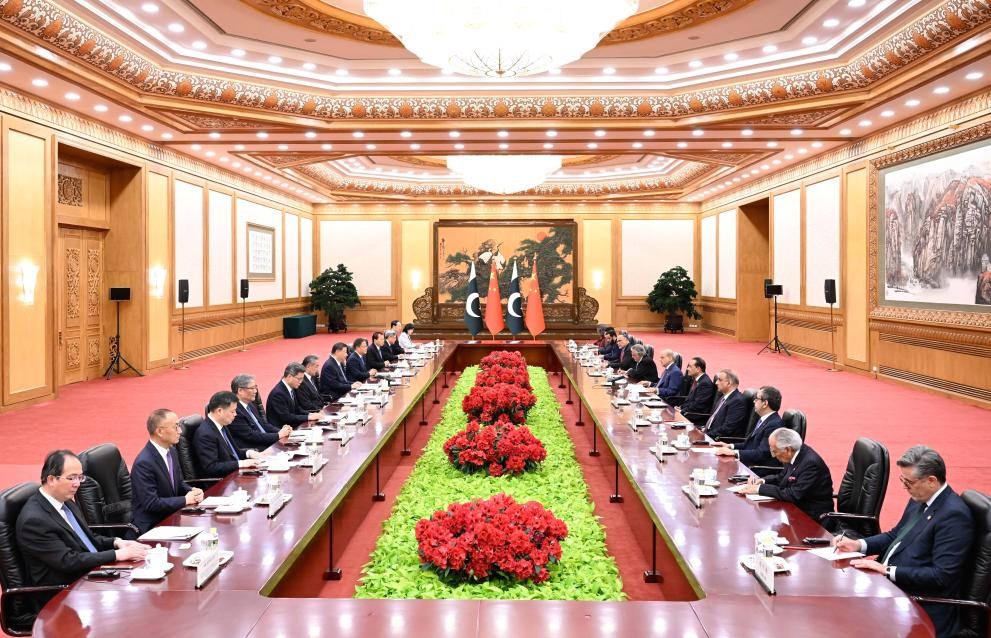
Between May 22nd and 26th, Pakistan’s political and military leadership undertook a series of engagements in Tehran and Beijing against the backdrop of the U.S.-Iran war. In Tehran, Pakistan’s Army Chief Asim Munir held discussions with Iranian President Masoud Pezeshkian, Parliament Speaker Mohammad-Bagher Ghalibaf and Foreign Minister Abbas Araghchi. He later accompanied Prime Minister Shehbaz Sharif to Beijing as part of a high-level delegation that included Foreign Minister Ishaq Dar for meetings with Chinese President Xi Jinping and Premier Li Qiang to mark 75 years of diplomatic relations between the two countries.
The sequencing of these engagements offers an important insight into the broader strategic context surrounding Islamabad’s diplomatic positioning at the time of the Beijing visit. The Pakistani delegation arrived in Beijing at a moment of heightened regional uncertainty, attempting to position itself simultaneously as Beijing’s closest strategic partner in South Asia and as a channel of communication between Tehran, the Gulf states and Washington amid the escalating regional crisis.
This intermediary role was acknowledged explicitly in both Chinese and Pakistani official messaging. Xi Jinping publicly praised Pakistan for “taking the initiative to play a mediating role in restoring peace in the Middle East”, while the joint communiqué issued at the conclusion of the visit appreciated Islamabad’s efforts in facilitating dialogue linked to the temporary U.S.-Iran ceasefire. The language was notable not only for its diplomatic signalling, but also because it reflected Beijing’s growing recognition of Pakistan’s utility within a rapidly changing regional environment.
However, the significance of the visit extended beyond the immediate geopolitical fallout of the Iran conflict. The three-day long diplomatic engagement in Beijing captured a broader transition underway within China’s regional and economic strategy. Over the past few years, Beijing has gradually shifted away from the debt-intensive infrastructure expansion associated with the earlier phase of the Belt and Road Initiative towards smaller, technologically focused and politically sustainable forms of overseas engagements. The language surrounding the much-discussed CPEC 2.0 during Sharif’s visit strongly reflected this reorientation with official statements repeatedly emphasising “high-quality development,” industrial cooperation, agricultural modernisation, digital connectivity, science and technology cooperation and third-party participation in future CPEC projects.
The convergence of these geopolitical and economic shifts have made Sharif’s visit more significant than a routine bilateral engagement. Increasingly, Pakistan appears to be occupying a more expansive role within China’s regional strategy, not only as the location of strategic connectivity projects, but also as a diplomatic intermediary and a testing ground for Beijing’s evolving model of overseas engagements.
Pakistan’s Expanding Strategic Utility Amid the Iran Crisis
Both China and Pakistan possess direct material stakes in any prolonged instability in the Gulf. According to Chinese analysts, nearly 44 per cent of China’s crude oil imports transit through the Strait of Hormuz, making sustained disruption a major strategic concern for Beijing. Pakistan’s vulnerabilities are equally acute. Gulf states account for a substantial share of Pakistan’s remittance inflows (Saudi Arabia and the UAE together contributing nearly half of total inflows in FY2024), while it continues to remain heavily dependent on energy imports routed through the same maritime corridor.
Beijing has remained an important trading partner of the Gulf Cooperation Council for several consecutive years, with bilateral trade reaching approximately USD 315 billion in 2022. Simultaneously, China has continued to deepen long-term energy ties with both Saudi Arabia and Iran. Saudi Arabia has remained one of China’s largest crude oil suppliers, with Chinese imports from the kingdom reaching nearly 78.64 million metric tons in 2024 alone.
Chinese investments linked to ports, industrial zones and logistics corridors across the Arabian Sea and western Indian Ocean have further increased Beijing's stake in regional stability. Gwadar under CPEC, the Khalifa port terminal operated by China based COSCO Shipping Ports and expanding Chinese commercial presence across Gulf logistics infrastructure collectively form part of a wider regional connectivity architecture tied to the Belt and Road Initiative. Any prolonged instability in the Gulf therefore carries implications not only for Chinese oil imports, but also for the wider commercial viability of Beijing’s regional connectivity strategy.
Under such conditions, Pakistan’s ability to maintain working relations across multiple regional poles acquires greater significance for China, particularly at a time when Beijing is seeking to avoid direct military involvement in regional crises despite its expanding economic footprint. Islamabad’s simultaneous engagement with Tehran, Washington, Gulf states and Beijing during the crisis reinforces its utility for a Chinese leadership increasingly concerned with protecting economic interests without becoming directly entangled in regional security competition.
CPEC 2.0 and China’s “Small but Beautiful” Reorientation
The strategic transition visible in China’s regional approach was equally reflected in the evolving language surrounding CPEC 2.0 during Sharif’s visit. Earlier phases of China-Pakistan economic engagement were primarily centred on large-scale infrastructure financing and strategic connectivity. The latest bilateral messaging, however, suggested a different framework increasingly focused on technological integration, industrial cooperation and economically sustainable forms of engagement. According to Pakistan's Minister for Planning, Development and Special Initiatives Ahsan Iqbal, 43 CPEC projects worth $25 billion were completed during the first CPEC phase, adding 8,800 megawatts of electricity to Pakistan's national grid through 17 power plants, and associated transmission infrastructure to address the chronic power shortages that had constrained industrial activity for years.
However, the limitations within this model gradually became visible for both Beijing and Islamabad. Pakistan faced mounting repayment pressures, implementation delays and recurring balance-of-payments vulnerabilities, while China encountered increasing security risks linked to repeated attacks on Chinese personnel and projects, particularly in Baluchistan and Khyber Pakhtunkhwa. Chinese policy discussions recently have also raised concerns surrounding the long-term sustainability of highly visible and capital-intensive infrastructure deployments in politically volatile environments, particularly in high-risk partner states.
CPEC 2.0 appears to be designed as a response to these constraints rather than a simple continuation of the earlier framework. Over the past few years, Chinese policy discourse surrounding the BRI has increasingly shifted toward what officials describe as “small but beautiful” projects. The phrase gained institutional weight at the Third Belt and Road Forum in October 2023, where Xi Jinping announced that China would carry out practical BRI cooperation by promoting both signature as well as small-scale projects. The phrase showcased Beijing’s growing preference for smaller-scale, commercially viable and politically sustainable overseas investments capable of generating long-term technological and economic influence with lower financial exposure.
Agriculture also featured prominently in the bilateral discussions. Both sides agreed to expand cooperation in agricultural technology, seed development, water-saving irrigation and agro-industrial modernisation. For Beijing, such cooperation aligns closely with larger concerns surrounding food security and supply-chain resilience, particularly after disruptions caused by the pandemic and global commodity volatility. For Pakistan, agriculture offers a sector where Chinese investment can produce visible domestic economic gains without the financial burdens associated with large infrastructure borrowing. Similarly, technology cooperation also formed a major pillar of future engagements with the joint statement emphasising collaboration in digital infrastructure and science and technology cooperation, hinting that future phases of CPEC are likely to move increasingly toward technological integration rather than traditional physical connectivity alone.
Collectively, the language and priorities surrounding the visit suggest that Beijing’s Pakistan strategy is undergoing a practical change. Earlier phases of the relationship were defined primarily through infrastructure expansion and strategic connectivity under CPEC. The newer framework appears more focused on embedding Chinese influence through technology, agriculture, industrial cooperation and politically manageable investments operating alongside deeper security coordination.
While the Iran conflict may have accelerated Pakistan’s immediate strategic relevance for China, the evolution visible within CPEC 2.0 indicates that Beijing’s longer-term reorientation of both its Pakistan policy and wider Belt and Road engagement had already been underway prior to the current regional crisis. Sharif’s visit therefore was not simply about reaffirming the traditional symbolism of the “all-weather partnership”. Rather, it epitomises a broader restructuring in how both Beijing and Islamabad are increasingly redefining the utility of the relationship under changing regional and economic conditions.
Author
Ratish Mehta
Ratish Mehta is a Senior Research Associate at ORCA. He is the co-editor of the Special Issue on India’s Soft Power Diplomacy in South Asia and serves as the co-lead for the project ‘The Episodes of India-China Exchanges: Modern Bridges and Resonant Connections’, which is rooted in the desire to enhance public consciousness of cross-cultural contributions of both societies. Ratish’s area of interest includes understanding the value of Narratives, Rhetoric and Ideology in State and Non-State interactions, deconstructing political narratives in Global Affairs as well as focusing on India’s Foreign Policy interests in the Global South and South Asia. He was previously associated with The Pranab Mukherjee Foundation and has worked on projects such as Indo-Sino relations, History of the Constituent Assembly of India and the Evolution of its Democratic Institutions. He is also the co-convenor of ORCA's Global Conference on New Sinology (GCNS), which is India's premier dialogue driven China conference. He is an alumnus of Ambedkar University, Delhi.