
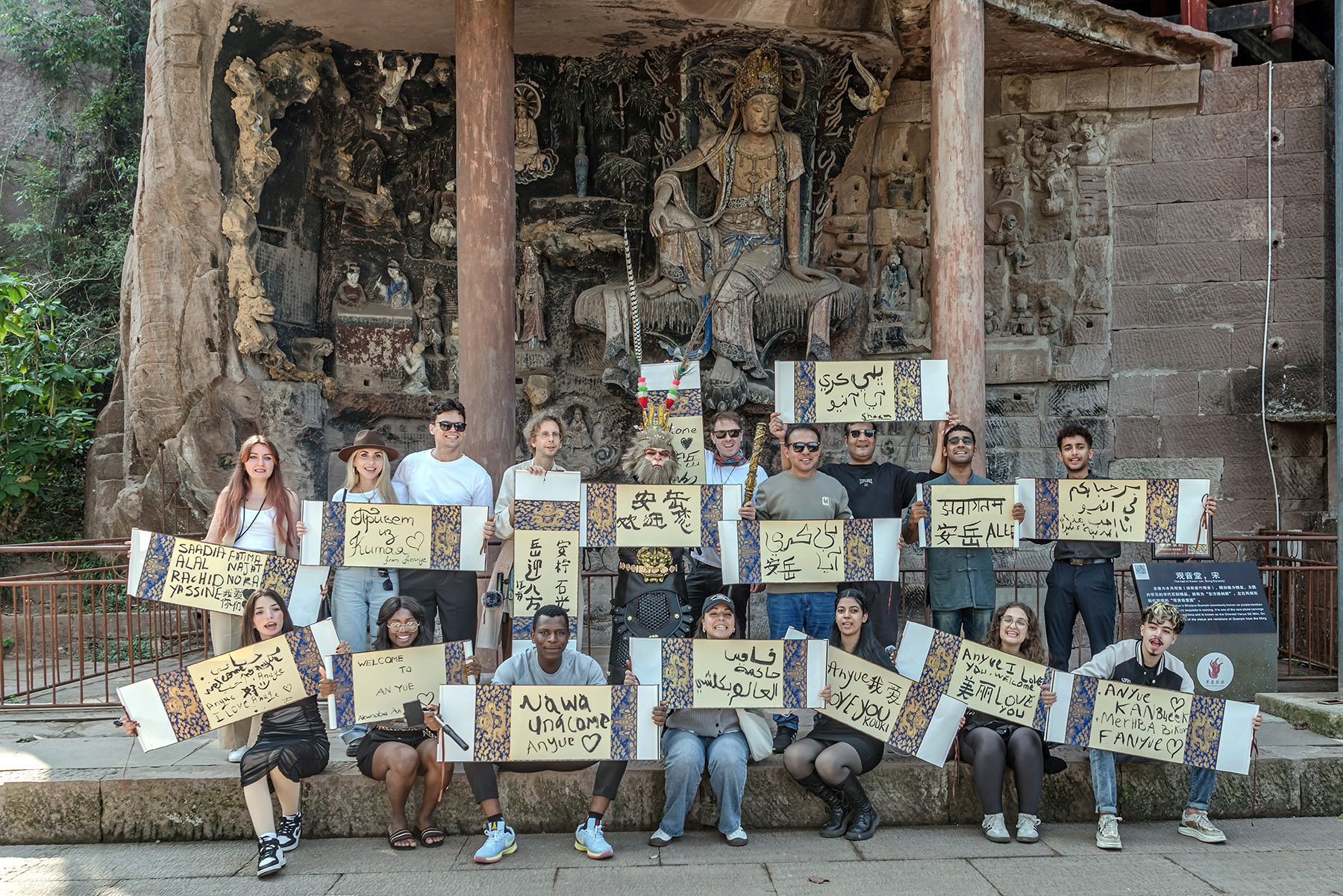
When Chinese Ambassador to India Xu Feihong recently shared a video of foreign tourists discussing their experiences in China, his accompanying message, “Seeing is believing,” captured an important shift in Beijing’s approach to national image-building. The video linked improving perceptions of China to social media influencing, with tourists pointing to how influencer content and personal experiences shared online shape views of the country alongside conventional media. In this changing information environment, the reach and ease of access to news provided by a foreign influencer have become a powerful resource for the Communist Party of China’s (CPC) international communication.
Changing patterns of media consumption have broadened the reach of influencers, with younger generations having grown up with social media and older audiences becoming more active on digital platforms. This new type of media has reshaped how information is produced and consumed, with foreign creators, technology reviewers and lifestyle creators now operating alongside official channels as additional sources of visibility and credibility. Rather than replacing its traditional propaganda apparatus, the CPC and its various agencies are adapting to this changing media environment, using social media and third-party voices to broaden the reach of state-mandated narratives.
The Transformation of Chinese Propaganda
This shift forms part of the CPC’s broader effort to strengthen China’s international communication capacity. During the Politburo's May 2021 collective study session on international communication, President Xi called for "telling China's story well," (讲好中国故) through "true, multidimensional and comprehensive" presentation of China. Central to this effort was strengthening China’s international discourse power, or huàyǔ quán (国际话语权), to match its comprehensive national strength and international status. The strategy also called on different regions and departments to leverage their respective strengths and develop more innovative and targeted communication for different countries and audiences. International communication was further brought into the ideological responsibilities of Party committees and Party schools, linking external narrative-building more closely to the Party’s governance apparatus.
Official commentary surrounding President Xi's 2021 remarks framed stronger international communication as a response to a contested global information environment, pointing to narratives such as the “China threat” and “China collapse” theories and the politicisation of COVID-19. Consequently, the CPC started integrating international communication into its national security framework, treating narrative-building as an essential component of statecraft that extends across different parts of the Party-state apparatus. This institutionalisation is reflected in the activities of agencies such as the Cyberspace Administration of China (CAC) which has supported international communication initiatives involving foreign influencers, while the United Front Work Department (UFWD) has expanded “online united-front work” to engage new-media practitioners and online opinion leaders. Recent Chinese scholarship similarly frames national communication capacity as part of governance modernisation. As China enters the 15th Five-Year Plan period, scholars argue that digital transformation should extend beyond industrial upgrading to the governance of narratives, with artificial intelligence and digital platforms playing a greater role in strengthening cultural soft power and international communication capacity.
Within this changing communication architecture, foreign creators are emerging as useful intermediaries between China's official narratives and international audiences. Videos by foreign influencers showcasing Shanghai's futuristic skyline, Chongqing's urban infrastructure or Sichuan's culinary traditions rarely resemble conventional political messaging. Instead, they present China as technologically advanced and stable through their curated renditions. A travel vlogger documenting a high-speed rail journey or an influencer focusing on technology and reviewing Chinese electric vehicles seems to offer independent observation rather than state-sponsored communication. However, from the perspective of strategic communication, the distinction between personal storytelling and national image-building has become blurred. This communication ecosystem also contributes to the CPC's use of governmentality by reinforcing the narrative of competent governance and national rejuvenation. Positive portrayals by foreign creators, recirculated through Chinese state media, serve as external validation of the Party's developmental model, seeking to strengthen domestic confidence in its governance.
Digital Soft Power through the Creator Economy
Thus, the Party governs through networks that combine public institutions, private social media platforms as well as provincial and market actors. Provincial governments like Zhejiang and Jilin have established International Communication Centers (国际传播中心) to facilitate collaborations with overseas journalists, content creators and social media personalities. They organise media tours, cultural festivals and technology exhibitions while providing logistical support for content creation. Their role extends beyond tourism promotion by creating opportunities for foreign creators to experience China firsthand and reinforce the Party's broader communication objectives.
The emphasis on everyday life, culture and development also aligns with a wider shift in Chinese diplomacy towards presenting engagement with China through exchange rather than overtly political messaging. The Global Civilisation Initiative (GCI) explicitly calls for stronger international people-to-people exchanges, while the Community with a Shared Future for Mankind (人类命运共同体), provides the normative framework through which Beijing presents exchange, development and mutual learning as alternatives to ideological confrontation. Through creator-led diplomacy, abstract ideas such as civilisational exchange are presented through accessible narratives about food, technology, cities and everyday life. This approach is also visible in the promotion of flagship projects such as Xiong'an New Area, smart-city initiatives and advanced manufacturing parks where visits by foreign journalists and digital creators turn China's development priorities into first-hand experiences that can be documented and shared with international audiences.
Influencers in Contested Political Spaces
The political value of such communication becomes particularly significant when these narratives reach audiences in countries where perceptions of China are shaped by geopolitical tensions and disputed claims of territorial sovereignty. India offers a particularly revealing example of how creator-led narratives operate within a previously strained political relationship with China. Following the Galwan Valley clashes in 2020, Indian attitudes towards China deteriorated sharply, and the Indian government banned numerous Chinese applications and tightened scrutiny of Chinese investment. However, this political deterioration has coincided with a different form of engagement at the societal level, with Indian travel creators documenting Chinese culture and technology for audiences at home. In 2026, Manipuri actress Soma Laishram was invited by Yunnan Media Group to attend the Water Festival in Xishuangbanna, illustrating how provincial media institutions have facilitated engagement with Indian public figures and through their digital presence, extended these exchanges to wider Indian audiences. The Chinese Embassy's digital activity further demonstrates how independently produced content can enter official communication channels, with its spokesperson Yu Jing amplifying Indian creators whose first-hand experiences of China are used to counter negative perceptions of the country.
Xinjiang demonstrates more clearly how state institutions can deliberately incorporate foreign creators into external communication. In 2025, the State Council Information Office (SCIO) issued a White Paper (白皮书) portraying the successes of Xinjiang as an ideal model of poverty alleviation and counterterrorism, while rejecting allegations of human rights abuses. Alongside these official statements, the "Xinjiang Vibes" campaign jointly organised by the Information Office of the People's Government of the Xinjiang Uygur Autonomous Region and China Media Group (CMG) invited influencers from 14 countries to travel across Xinjiang and create social media content showcasing the region’s “ethnic integration” and “rural revitalisation.” Crucially, organisers stated that the resulting material would be distributed both through the influencers' own social-media accounts and CMG's international network. This hybrid model brings together the international reach of foreign influencers with the access, organisational capabilities and amplification provided by official institutions.
The logic of digital storytelling extends beyond image-building to questions of sovereignty and national identity. In February 2026, an article published on the United Front Work Department's (UFWD) website described “online united-front work” (网络统战) as an integral component of united-front strategy, identifying new-media practitioners and online opinion leaders as important groups who influence public opinion. It further called for online united-front work to be integrated across different areas of united-front activity, using digital platforms to broaden political outreach and build consensus. Consequently, in June 2026, China's Taiwan Affairs Office openly encouraged "Taiwan compatriots, including internet influencers," to visit the mainland, "learn about it in various ways, introduce it to others, and share their real experiences and development opportunities." Furthermore, state media also featured Taiwanese influencers documenting China as part of China Daily's series on Taiwan-related issues, which explicitly seeks to counter what it describes as disinformation from the Democratic Progressive Party (DPP) administration. The strategic significance of these first-hand accounts also lies in their ability to reach and circulate narratives of mainland development to audiences across the Strait.
Viewed through the lens of governance, China’s engagement with foreign creators reflects an expansion of how the Party manages communication in the digital era. Direct regulation and censorship remain important, but they now operate alongside a more networked approach in which state institutions can amplify selected voices and extend narratives through platforms and audiences beyond the reach of traditional state media. This indirect management of narratives operates alongside the CAC’s direct regulation and censorship of digital space, allowing the CPC to shape not only what is restricted but also which representations of China gain greater visibility and circulation. Foreign creators are particularly significant within this model because their content can travel through audience networks that official communication may struggle to access directly. Taken together, these developments mark a broader evolution in “telling China’s story well,” towards a state-facilitated communication model that draws on digital platforms and third-party voices to extend China’s influence across borders.
Image Credit: China Daily
Author
Chitra Nair
Chitra Nair is a postgraduate in Chinese Studies from SOAS University of London, holding a bachelor’s degree in International Relations with a minor in Environmental Studies from FLAME University, India. Her research explores contemporary Chinese politics, digital activism, political expression and censorship. She is especially interested in how the state and citizens negotiate power and legitimacy, questions which she seeks to explore through a political sociology lens. She previously interned at the Institute of Chinese Studies, New Delhi, where she published work on media censorship and the queer community in China. Her dissertation, Digital Panopticon : Activism and State Surveillance in China, examines digital activism and censorship in China through three key case studies.