
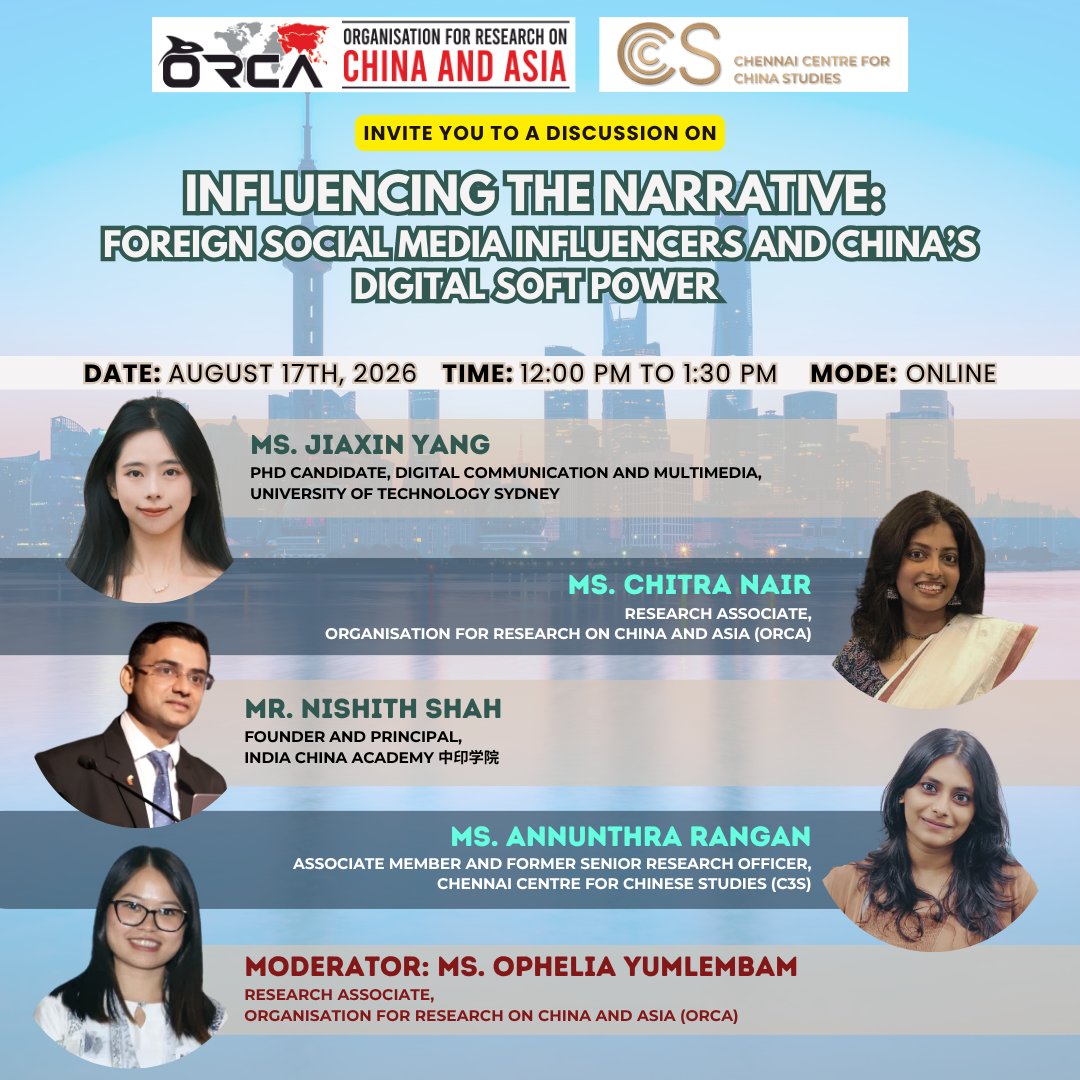
Organisation for Research on China and Asia (ORCA) co-hosted an online webinar with the Chennai Centre for China Studies (C3S) titled “Influencing the Narrative: Foreign Social Media Influencers and China’s Digital Soft Power” on 17th August, 2026. The session was moderated by Research Associate Ms. Ophelia Yumlembam, and featured Ms. Chitra Nair, Mr. Nishith Shah, Ms. Jiaxin Yang and Ms. Annunthra Rangan as discussants. The discussion examined how China leverages foreign social media influencers as a form of digital soft power to shape narratives and build credibility, while evaluating India’s response to its expanding digital outreach.

Ms. Chitra Nair argued that China’s growing use of foreign social media influencers is part of its new international communication strategy. She highlighted how Beijing connects state institutions, digital platforms and foreign creators to promote favourable narratives through lifestyle and technology content. She concluded that China is moving beyond traditional media to shape the digital infrastructure, networks and algorithms through which its narratives reach global audiences.

Mr. Nishith Shah reflected on the growing virality of social media content on China. He highlighted how China’s digital ecosystem is shaped by multilayered cybersecurity laws and regulations. These mechanisms filter content perceived to be in friction with the state, allowing the state to blur the line between organic and state-supported content. He also emphasised the need for India to recognise this evolving dimension of digital power.

Ms. Jiaxin Yang examined Chinese audiences’ responses to foreign influencer content, noting that it can generate both critical and celebratory views. She argued that its effectiveness depends on how the content is produced and amplified, while greater transparency on state involvement could enhance trust. She also noted that not all foreign influencer content should be viewed as propaganda, stressing that audience reception ultimately shapes the impact of the strategy.

Ms. Annunthra Rangan argued that China’s influence strategy should be understood as a long-term approach to international engagement and communication, rather than viewed simply through the lens of propaganda. She highlighted the need to examine who facilitates, amplifies and benefits from such content. Drawing lessons for India, she suggested leveraging cinema, food, literature and other cultural assets to strengthen its digital presence.

Moderator Ms. Ophelia Yumlembam directed the discussion towards how China integrates foreign influencers with initiatives such as the Global Civilisation Initiative and people-to-people exchanges, how influencer-led narratives shape perceptions of Beijing, and their implications for India’s information ecosystem.

The session concluded with an engaging Q&A session that examined the growing influence of foreign influencers in shaping China’s global image and how India can respond to this newer soft power tool.