
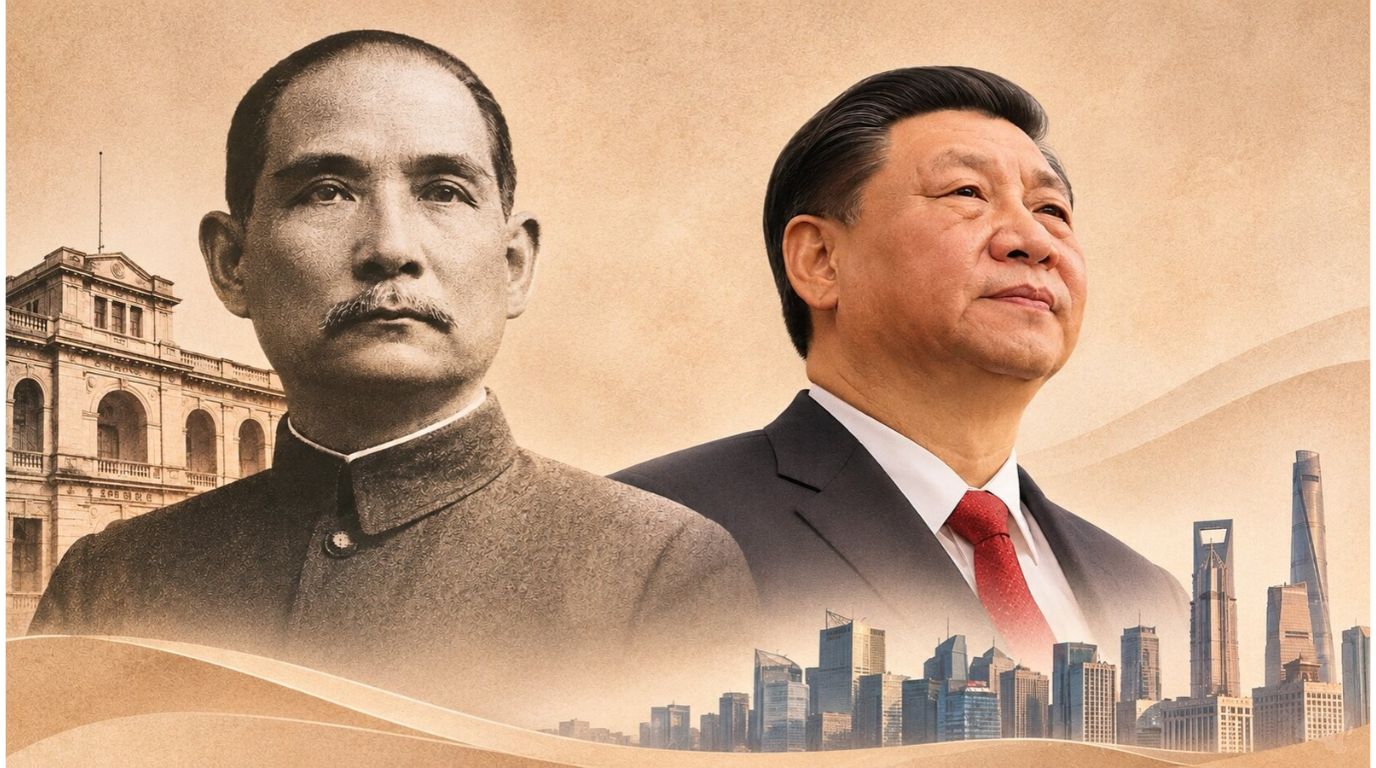
Chinese President Xi Jinping's commemoration of Sun Yat-sen's 160th birth anniversary on 12 November 2026 was more than a ceremonial tribute to a revolutionary predecessor. In his speech, Xi not only reaffirmed Beijing's resolve to achieve Taiwan's reunification but also reiterated the Communist Party of China's (CPC) claim to be Sun's political successor. Furthermore, underlying this speech was a more consequential assertion about China's modern history: Sun initiated the struggle for national revival, but the CPC has realised much of his vision and claims the authority to complete his unfinished mission. By invoking Sun’s legacy, Xi situates the Party's contemporary objectives within a nationalist tradition predating Communist rule, while presenting reunification as an essential component of the great rejuvenation of the Chinese nation (中华民族伟大复兴). Xi’s commemoration thus illustrates how the CPC selectively interprets history to reinforce its political authority and advance its vision for China's future.
Reinterpreting Sun's Legacy
During the 150th birth anniversary commemoration in 2016, Xi described Chinese Communists as Sun's “most steadfast supporters, most loyal collaborators and most faithful successors” (最坚定的支持者、最忠诚的合作者、最忠实的继承者). A decade later, Xi reiterated this claim, placing the CPC's successive political and developmental achievements within a broader narrative of fulfilling Sun's ambitions. The distinction between the two speeches lies in how Xi situates the CPC's achievements within the broader objective of national rejuvenation. In 2016, he emphasised that China was closer than ever to achieving national rejuvenation, citing the Party's revolutionary and developmental accomplishments as the foundation for this confidence. Ten years on in 2026, he more explicitly presented the successive achievements of revolution, socialist nation-building, reform and modernisation as evidence of the CPC's historical role in advancing Sun's aspirations. Sun's legacy thus allows Xi to strengthen the CPC's historical legitimacy and political authority by portraying its governance achievements as the fulfilment of aspirations that earlier revolutionary movements could not realise.
This claim to historical succession also rests on a selective interpretation of Sun's political ideals. Xi, in his speech, linked Sun’s patriotism to Party leadership, public welfare to common prosperity (共同富裕) and the pursuit of truth to adapting Marxism to Chinese conditions. He also connected Sun’s emphasis on unity and international cooperation to the CPC’s united front strategy and global governance vision.
However, this interpretation foregrounds the nationalist and developmental dimensions of Sun's thought while downplaying its distinct democratic foundations. Sun's Three Principles of the People (三民主义), encompassing nationalism, democracy and people's livelihood, emerged from a political tradition fundamentally different from Marxism-Leninism. While Sun advocated republican government and political representation, Xi emphasised those elements of his legacy that could be reconciled with the CPC’s political priorities. Such selective reading allows Xi to claim continuity with China's pre-Communist revolutionary tradition while overlooking the differences between their political visions.
Taiwan and the Limits of a Shared Legacy
Sun's political relevance becomes especially pronounced in Beijing's approach towards Taiwan. As the founding figure of the Republic of China and an important figure in the Kuomintang's (KMT) political tradition, Sun provides Beijing with a shared historical reference point to frame reunification as a broader nationalist objective rather than exclusively a CPC agenda.
Building on his emphasis on national unity from 2021 speech, Xi's 2026 speech affirmed reunification as an essential requirement of national rejuvenation while placing greater focus on political engagement and dialogue. However, this relatively conciliatory language should not be mistaken for a shift in Beijing's fundamental position. For Beijing, cross-strait dialogue remains conditional on consensus regarding the one-China principle and the 1992 Consensus. Beijing's emphasis on dialogue also contrasts with its continued military pressure on Taiwan. Although Xi's latest speech made no explicit reference to the use of force, Chinese military aircraft and warships conducted operations around Taiwan on the very same day. Thus, invoking Sun's legacy allows Beijing to broaden political outreach without altering its reunification objectives.
Yet, Sun's shared historical significance does not translate into agreement over his political legacy. While Beijing emphasises his commitment to national unity to justify reunification under CPC leadership, Taiwan's political traditions also associate Sun with the founding of the Republic of China and its republican institutions. This divide was evident in the Cross-Strait Peace Initiative, where a former Taiwanese official proposed a ten-year roadmap towards reunification. The KMT clarified that the proposal was not the official party policy, while at the same time, reaffirming its support for peaceful cross-strait engagement. This illustrates how a shared historical legacy does not necessarily translate into agreement over Taiwan's political future.
Ahead of the commemorations, Taiwan's Mainland Affairs Council also criticised Beijing's use of Sun's legacy to promote reunification through united front activities. Following Xi's speech, it reiterated that the Republic of China established by Sun continued to exist and that Taiwan's future must be determined by its people. These competing positions reveal the limitations of Beijing’s narrative, as a shared nationalist legacy does not necessarily translate into agreement over Taiwan’s sovereignty or political future.
Modernisation as Evidence of Historical Succession
Beyond Taiwan, China's contemporary development achievements provide Xi with tangible evidence to support the CPC's claim to have fulfilled Sun's ambitions. In The International Development of China (实业计划), Sun had outlined extensive proposals for railway networks, highways, ports, inland waterways and hydropower infrastructure, reflecting his belief that national revival required economic and industrial transformation.
During his recent visit to Sun's former residence in Guangdong, Xi argued that China had realised or surpassed many of these aspirations. China's railway network, which has exceeded Sun's proposed 160,000 kilometres, the construction of the Three Gorges Dam and the port-led development in Eastern China provide tangible examples of this developmental continuity. The Pinglu Canal, opened in September 2026, offers another contemporary illustration, advancing Sun's vision of developing Qinzhou into a major maritime gateway for southwestern China. Although these projects were not necessarily implemented according to Sun's original designs, Beijing presents them as the fulfilment of his century-old aspirations. Such connections serve a political purpose beyond celebrating infrastructure achievements. They aim to strengthen the CPC's claim that its institutional capacity has enabled China to overcome the constraints that previously hindered the fulfilment of nationalist ambitions.
By linking these achievements to Sun's original ideal of revitalising China (振兴中华), Xi presents the CPC's development record as a source of its political legitimacy. This interpretation also extends Sun's ambitions beyond their original context, incorporating them into a contemporary modernisation agenda centred on technological self-reliance, industrial upgrading and national security. The emphasis is on CPC’s claimed ability to advance China's development and national rejuvenation under its continued leadership.
Sun Yat-sen's enduring relevance to Xi Jinping ultimately reflects the CPC's broader objective to establish political authority through historical continuity. By incorporating Sun's revolutionary ideals into its own narrative, the Party seeks to portray contemporary Chinese-style modernisation (中国式现代化) and reunification as the culmination of a national project extending beyond Communist rule. Yet the competing interpretations of Sun's legacy, particularly across the Taiwan Strait, expose the limits of this historical claim. Xi's invocation of Sun therefore reveals how the CPC uses the past not merely to legitimise its achievements, but to shape the political terms on which China's future is defined.
Author
Omkar Bhole
Omkar Bhole is a Senior Research Associate at the Organisation for Research on China and Asia (ORCA). He has studied Chinese language up to HSK4 and completed Masters in China Studies from Somaiya University, Mumbai. He has previously worked as a Chinese language instructor in Mumbai and Pune. His research interests are India’s neighbourhood policy, China’s foreign policy in South Asia, economic transformation and current dynamics of Chinese economy and its domestic politics. He was previously associated with the Institute of Chinese Studies (ICS) and What China Reads. He has also presented papers at several conferences on China. Omkar is currently working on understanding China’s Digital Yuan initiative and its implications for the South Asian region including India. He can be reached at [email protected] and @bhole_omkar on Twitter.