
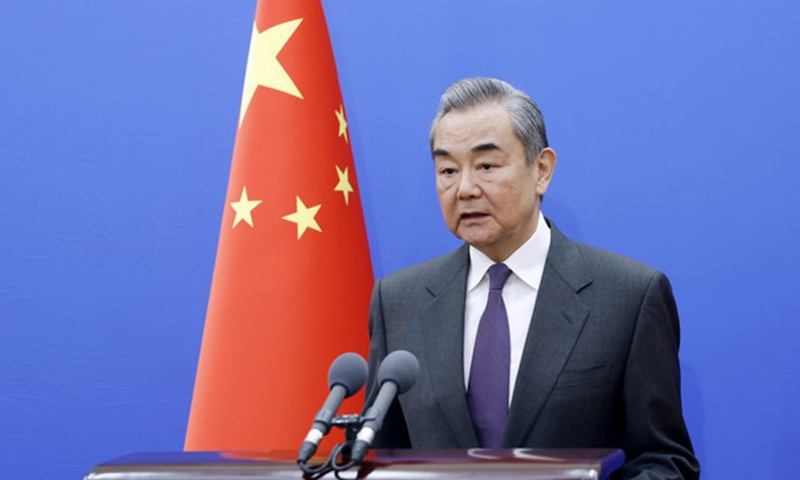
With the world’s attention fixed firmly on the unrest in Iran and a post-Maduro Venezuela, Chinese Foreign Minister Wang Yi’s diplomatic visit of Africa went relatively unnoticed. For the past 36 years, the African continent has been the Chinese foreign minister’s first overseas destination, but Wang Yi’s visit to Ethiopia, Tanzania, Lesotho, and Somalia from 7–12 January 2026 was more than a ritual. It underscored Beijing’s deliberate strategy to anchor its global diplomacy in Africa and was directly relevant to its stakes in great power competition and vision for an alternative international order.
At a time when the Trump administration’s policies limit the appeal of US engagement to governments in the Global South, China is moving quickly by consolidating its advantages and reinforcing its position in Africa. China’s approach to the Global South is being refined to sharpen its efficacy, and is adapting to overcome regional and global pressures. This process of recalibration is most visible in Africa, which anchors Beijing’s leadership ambitions of the Global South.
Consolidating Relationships
According to the Chinese Ministry of Foreign Affairs, Ethiopia was chosen as the first stop because of the all-weather strategic partnership between the two countries. Ethiopia is also important for Beijing’s broader regional engagement: it is one of Africa’s fastest-growing economies, home of the African Union (AU) and a formal member of BRICS. Cultivating strong ties with Ethiopia multiplies Beijing’s influence in key multilateral institutions representing the Global South. By beginning his visit in Ethiopia to advance an important diplomatic relationship, Wang Yi sought to reinforce the stated model for building a China-Africa community with shared future for the new era (新时代中非命运共同体构建).
China has capitalized on an opportunity to draw Ethiopia further into its orbit as Addis Ababa remains suspended from the US Asia Growth and Opportunity Act (AOGA) and US President Donald Trump offers to mediate the Great Renaissance Dam (GERD) dispute. During Wang Yi’s visit both sides discussed cooperation in the field of e-commerce, energy, tourism, education and digital economy, deepening China’s economic presence in Ethiopia. It is worth noting that Ethiopia is the second largest recipient of Chinese development finance in the region and is in talks to convert its dollar debt to yuan. The economic pragmatism of converting debt payments to Yuan for governments like Ethiopia and Kenya expands the internationalization of the RMB, while retaining the influence derived from debts owed to China.
Wang Yi also co-chaired the 9th China-Africa Strategic Dialogue at the AU, linking China and Africa’s respective development agendas. China backed Africa’s Agenda 2063, along with Silencing the Guns by 2030 initiative and Africa Continental Free Trade Area (AfCFTA) while receiving multilateral support for the Global Security Initiative (GSI), Global Governance Initiative (GGI) and International Organization for Mediation. It also launched the 2026 China-Africa Year of People-to-People Exchanges, promising to expand people-to-people ties through 600 activities in the domains of youth, culture and media exchanges. China’s AU engagement is likely to deepen its influence among political and intellectual elites across Africa, and align development agendas, thus enhancing the value of its Global South relationships at the state and society level.
Economic Partnerships and Political Alignment
Wang Yi’s visit to Tanzania and Lesotho, similar to Ethiopia, echoed the dynamic of reciprocity. In Tanzania, Beijing committed to synergizing implementation of Tanzania’s National Development Vision 2050 and in Lesotho, both sides agreed to “common development”. China’s engagement in Tanzania in particular was about linking its economic interests across the region through the TAZARA (Tanzania-Zambia Railway Authority) Implementation Project and the TAZARA Railway Prosperity Belt. Doing so grants China greater access to Zambia’s vast copper deposits, possible with the newly-signed agreement between Tanzania, Zambia and China to refurbish the TAZARA railway. Similarly, construction of the Bagamoyo port in Tanzania, which began in December 2025 following years of rollbacks and negotiations, is a win for China that will expand its commercial and trade footprint in the region.
Chinese diplomats in the region are already highlighting such economic linkages being advanced through trade and commerce, and playing up the “zero tariff” treatment extended to African countries (who recognize the PRC). The “zero-tariff” offering was described by Wang Yi in an interview as a “gift”, designed to distinguish Chinese economic engagement from US tariff actions. It also enables Beijing to secure diplomatic recognition for China instead of Taiwan. By promoting its trade and economic linkages, China is securing vital resource interests as well as ensuring alignment on core interests.
Another major takeaway from Wang Yi’s visit was the centrality of political alignment on core interests in the joint communiques issued by both sides. For instance, in the joint communique issued by Lesotho, Lesotho resolutely opposed any form of Taiwan independence and expressed support for all efforts by China to achieve national reunification. The same commitment was made by Tanzania, who reaffirmed its commitment to the one-China principle and supported China’s efforts to achieve national reunification. The statements show the centrality of political alignment on China’s core interests as preconditions determining cooperation and engagement.
Navigating Fissures
Navigating the emerging domestic political fissures in the region has complicated China’s consolidation of influence. Although the Chinese foreign minister was scheduled to travel to Somalia, the visit was postponed due to a “schedule change”. This is more likely due to a calculated assessment of the political and security risks facing the region. China has warned the breakaway region of Somaliland against “collusion” with Taiwanese authorities, and reiterated support for Mogadishu in defending its sovereignty. However, the cancelled visit has been interpreted by some observers as a symbolic failure to affirm Somalia’s sovereignty. Navigating such competing concerns emerging from domestic political fissures in African countries, to preserve the primacy of China’s interests, was a key facet of Wang Yi’s visit.
In Tanzania too, China sided with the Samia Hassan government who won the October election with 98% of the vote. Although the opposition in Tanzania and international observers have termed the exercise fraudulent, Beijing congratulated the government for “successful conduct” of elections and warned against foreign interference, indicating China’s alignment with the outcomes of Tanzania’s domestic political processes. Beijing’s stated position ensures that it retains the support and favour of a key regional partner, while navigating potentially contentious political issues.
On the economic front too, Beijing is executing a careful recalibration of engagement. Unlike previous occasions when China made announcements of large infrastructure projects in Africa, Wang Yi’s visit highlighted projects with a public diplomacy footprint. In an interview after his Africa visit, Wang Yi highlighted that 301 "small but beautiful" projects are progressing smoothly in the region.
China’s Africa diplomacy has long reflected an interest in ensuring unwavering support from a large bloc of Global South stakeholders. Securing their continuous commitment to Chinese Global Initiatives and development model raises China’s diplomatic profile in contrast to the US, and highlights its contributions to an alternative international order. Moreover, Africa’s support for China’s core interests like the One-China principle as well as on issues raised at the United Nations (UN) and other international fora has been established firmly as a condition for cooperation and engagement. Guaranteeing support from stakeholders of the Global South introduces much needed certainty in China’s external engagements.
Over the course of Wang Yi’s visit, Beijing has hence effectively secured alignment on diplomatic initiatives with stakeholders of the Global South, established a dynamic of reciprocity on core interests, refined its economic engagement and positioned China as the region’s preferred partner. Furthermore, Wang Yi’s visit has underscored the importance of effectively navigating emerging challenges in the region. Beijing is continuously recalibrating its economic and diplomatic strategy to stay abreast of fallout and frictions in its engagement of Africa. The paradigm of navigating pressures while establishing reciprocity to entrench influence now characterizes China’s diplomacy in Africa.
Image Credit: Global Times
Author
Rahul Karan Reddy
Rahul Karan Reddy is Senior Research Associate at Organisation for Research on China and Asia (ORCA). He works on domestic Chinese politics and trade, producing data-driven research in the form of reports, dashboards and digital media. He is the author of ‘Islands on the Rocks’, a monograph on the Senkaku/Diaoyu island dispute between China and Japan. He is the creator of the India-China Trade dashboard, the Chinese Provincial Development Indicators dashboard and co-lead for the project ‘Episodes of India-China Exchanges: Modern Bridges and Resonant Connections’. He is co-convenor of ORCA’s annual conference, the Global Conference on New Sinology (GCNS) and co-editor of ORCA’s daily newsletter, Conversations in Chinese Media (CiCM). He was previously a Research Analyst at the Chennai Center for China Studies (C3S), working on China’s foreign policy and domestic politics. His work has been published in The Diplomat, 9 Dash Line, East Asia Forum, ISDP & Tokyo Review, among others. He is also the Director of ORCA Consultancy.