
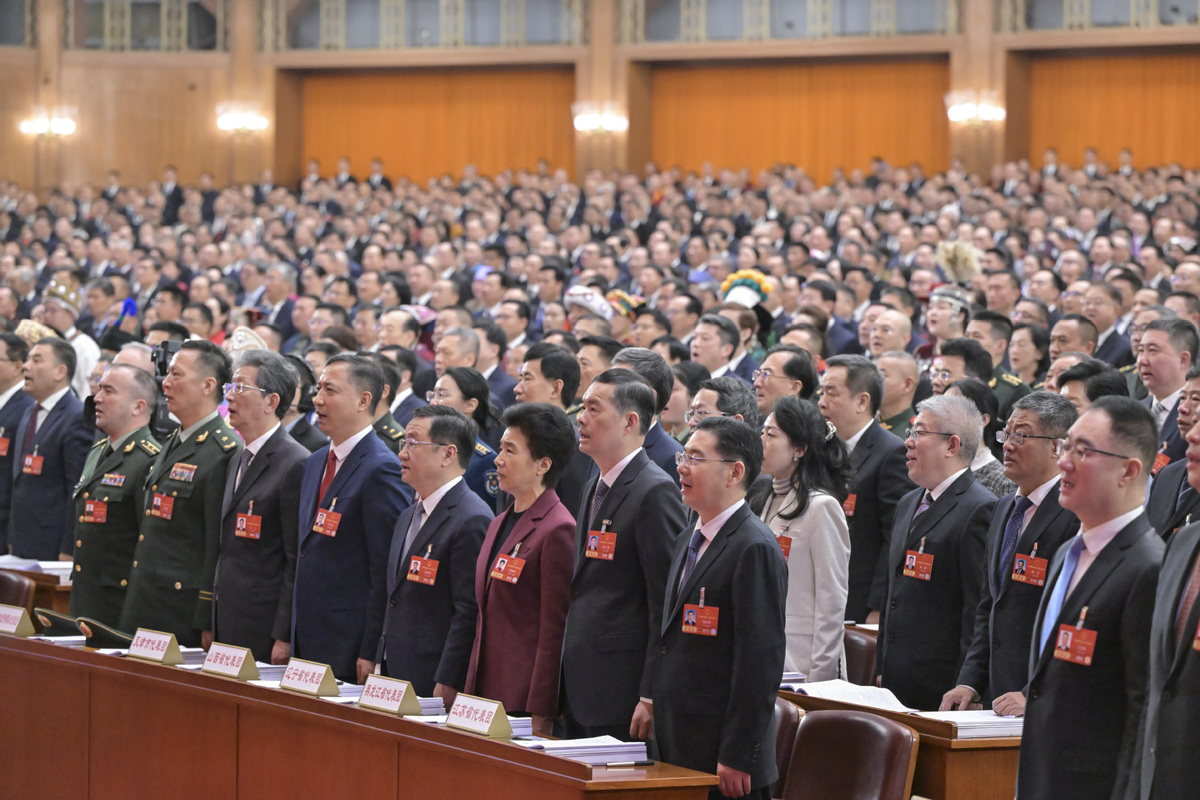
In the face of “great changes unseen in a century” (百年未有的大变局), the Government Work Report (GWR) for 2026 recently presented by Premier Li Qiang on behalf of the State Council at the Two Sessions, is meant to be an instrument projecting resilience, stability and continuity to realize the project of ‘national rejuvenation’ (民族复兴). The policy direction set at the Two Sessions of the National People’s Congress and Chinese People's Political Consultative Conference (CPPCC) communicate priorities for economic and social development for 2026 and the 15th Five Year Plan (FYP), guiding the behaviour of political actors, the private sector and social groups in China.
With a tumultuous external environment due to conflict in West Asia and domestic political instability emanating from leadership churn in China’s military, the GWR is instructive of how China plans to navigate 2026. As the main document outlining China’s policy plans and priorities, what does the GWR have in store for national development?
Economic Growth, Monetary and Fiscal policy
The most anticipated indicative signal of Beijing’s economic policy in 2026 is the target for GDP growth. Set at 4.5 – 5% with the qualification of “striving for better in practice”. In this GWR, China has set the lowest target since 1991 that reflects a realistic and necessary adjustment befitting a new development philosophy focused on high-quality growth instead of high-quantity growth. Zooming out, the steady erosion of targets relating to GDP growth, from 8% in 2010 to 4.5 – 5% in 2026, has inserted predictability into the deceleration of China’s economic growth. In fact, a closer look at provincial government targets announced in work reports in early February was enough to glean that the national target was likely to be trimmed below 5%. Interestingly, the qualification of “striving for better results” suggests China does not see the reduction in targets as a negative and is communicating the potential for attaining GDP growth of over 5% as well. The 2026 GWR further cushions the impact by arguing that structural adjustments, risk prevention and reform for the 15th FYP are considerations in 2026. Although downward pressures on growth engines like exports were offset in 2025, protectionism and trade disruptions already underway in 2026 will certainly impact growth prospects.
While the GWR is predictably open about external factors like trade protectionism, it is surprisingly candid about internal economic limitations. It argues that the foundations of growth are not strong enough, while demand and consumption remain weak. The main task for 2026 is thus focused on internal economic re-structuring, to build a national market that improves consumption and demand. The GWR promises to advance special initiatives for boosting consumption, allocate 250 billion yuan in ultra-long special treasury bonds for consumer goods trade-in programs, boost earnings of low-income groups and institute a fund of 100 billion yuan for loan interest subsidies, financing guarantees and risk compensation.
However, these measures are unlikely to be enough as long as real estate and the stock market dampen consumer confidence. Even then, domestic demand alone is unlikely to compensate for external drags and slowing exports. As a result, China continues to rely on state investment in 2026, allocating 735 billion yuan for investment in the central budget, 800 billion yuan from ultra-long special treasury bonds and new instruments worth 800 billion yuan to stimulate greater private sector investment.
Even the direction of monetary and fiscal policy outlined is geared towards acceleration of the structural shift in China’s economy. Driven by the need to ensure a rebound in prices, monetary policy will make timely cuts to reserve ratios and interest rates to ensure money supply is in “step with economic growth and CPI levels”. Deflationary pressures limiting economic growth are likely to be managed through looser monetary policy and lowered financing costs. China’s fiscal policy is also tuned to tackle deflationary pressures; the GWR states that government spending will be “fairly large in scale”. China has outlined increases of 230 billion yuan in government debt, 1.27 trillion yuan of budget expenditure, while planning to issue 4.4 trillion yuan of local government special-purpose bonds, and 300 billion yuan of special treasury bonds to replenish the capital of large state-owned commercial banks. Overall, monetary and fiscal policy is focused on easing deflationary pressures and creating the conditions for increased demand and consumption.
High-Quality Development, Innovation and Technology
China’s economic restructuring is underpinned by the emphasis on high-quality development, which is driven by new quality productive forces. The government’s second most important task of 2026 is thus to foster new growth drivers more quickly, protecting its global manufacturing strengths while cultivating new ones. For example, it calls for upgrading traditional industries by promoting large-scale equipment upgrades, which protects China’s manufacturing competitiveness while also pushing firms up the value chain. In a similar vein, technology-intensive industries will be promoted with greater policy support, financing and risk sharing mechanisms. Spending on R&D during the 15th FYP period has been targeted at 7% annually, and of the 109 major projects during the 15th FYP, 28 are designed focused on new quality productive forces, like renewable energy, quantum technology, embodied AI, brain-computer interfaces, and 6G technology.
While the GWR outlines support for innovation and technology breakthroughs, it also focuses on integration of new technologies with manufacturing, applications and services. The 2026 GWR promises to expand the market for science and technology services. It specifically discusses advancement and expansion of Artificial Intelligence (AI) in the form of agents, terminals and other large scale commercial application scenarios. A major driver of policy support for innovation is self-reliance in core technologies, which secures China from external shocks and guarantees domestic economic development. Thus, the 2026 GWR takes a comprehensive view of technology development, focusing on education, talent, financing, application, clustering and exchange. The GWR’s discussion of technology development is more robust in 2026, suggesting China is keen to commercialise technology advantages and leverage them for global competitiveness and domestic productivity gains.
Social Development, Stability and Politics
Economic factors impacting social stability are discussed extensively in the 2026 GWR. Rural revitalization is termed the “top priority”, with a multidimensional framework for agricultural development as detailed in the No 1 Central Document. Stability of food supply is to be secured through diversification, maintaining farmland red lines, managing offsetting of cultivated land and enhancement of disaster prevention. In this context, the extension of rural land contracts by another 30 years addresses a significant uncertainty for agricultural communities. China’s poverty alleviation program remains largely unchanged, but targeted and measured assistance has surfaced as the driving force. Social welfare policies have largely been viewed through the prism of improvements in employment, quality education and basic health services. The surveyed urban unemployment target has been set at 5.5%, unchanged from the previous year. China will also raise the minimum basic old-age benefits for rural and non-working urban residents by 200 yuan per month, expand unemployment coverage, trial occupational injury insurance and proactively respond to population ageing. Housing support for married couples, maternity insurance, subsidised childcare services and parental leave systems have been augmented to “foster positive attitudes towards marriage”. The raft of measures attempt to ease social pressures emerging from population changes, migration, unemployment and slowing income growth.
The GWR underscores the push to implement a new urbanization pattern and coordinated regional development strategy, bridging its economic and social development programs. Through more optimised zonal functioning, regions will be expected to leverage competitive advantages and complementary strengths. Similarly, key city clusters will be developed further to improve industrial upgradation, collaboration and cooperation.
Political issues remain a significant part of the 2026 GWR, particularly corruption and government performance. The document argues that the underlying condition for economic development is political stability and unified leadership, reiterating the Party view that political security is a condition for economic progress. Unsurprisingly, China plans to improve oversight over exercise of power, improve conduct, and intensify efforts to address corruption directly affecting the masses. The document even states the need for improvement in government performance, citing lack of coordination and cooperation in implementation and service-orientation.
With complex and long-term implications emanating from the conflict in West Asia, China’s external environment presents the GWR with an uphill battle, to manage growing uncertainty and mounting economic challenges. Although it has outlined a roadmap for economic and social development in 2026 with a strong emphasis on high-quality development and new quality productive forces, efforts to raise domestic demand and consumption may prove more challenging than anticipated. Securing the foundations for the long-anticipated transition in economic growth engines is dependent on the revival of market confidence, household spending and successful commercialisation of technology breakthroughs. Moreover, the focus on social stability reflects China’s sensitivity to economic downturns that impact employment, income growth and poverty alleviation. As a result, the policy roadmap for 2026 thus counterbalances the drive for innovation with social welfare interventions for rural communities, greater childcare expenditure support and expansion of unemployment insurance, reflecting a concern about the volatility, risk and uncertainties inherent to such a transition. Overall, the GWR adopts a comprehensive view of economic and social development in 2026, cautious to maintain stability and harmony while signalling urgency in facilitating transformations that meet growing economic expectations.
Image Credits: People's Daily
Author
Rahul Karan Reddy
Rahul Karan Reddy is Senior Research Associate at Organisation for Research on China and Asia (ORCA). He works on domestic Chinese politics and trade, producing data-driven research in the form of reports, dashboards and digital media. He is the author of ‘Islands on the Rocks’, a monograph on the Senkaku/Diaoyu island dispute between China and Japan. He is the creator of the India-China Trade dashboard, the Chinese Provincial Development Indicators dashboard and co-lead for the project ‘Episodes of India-China Exchanges: Modern Bridges and Resonant Connections’. He is co-convenor of ORCA’s annual conference, the Global Conference on New Sinology (GCNS) and co-editor of ORCA’s daily newsletter, Conversations in Chinese Media (CiCM). He was previously a Research Analyst at the Chennai Center for China Studies (C3S), working on China’s foreign policy and domestic politics. His work has been published in The Diplomat, 9 Dash Line, East Asia Forum, ISDP & Tokyo Review, among others. He is also the Director of ORCA Consultancy.