
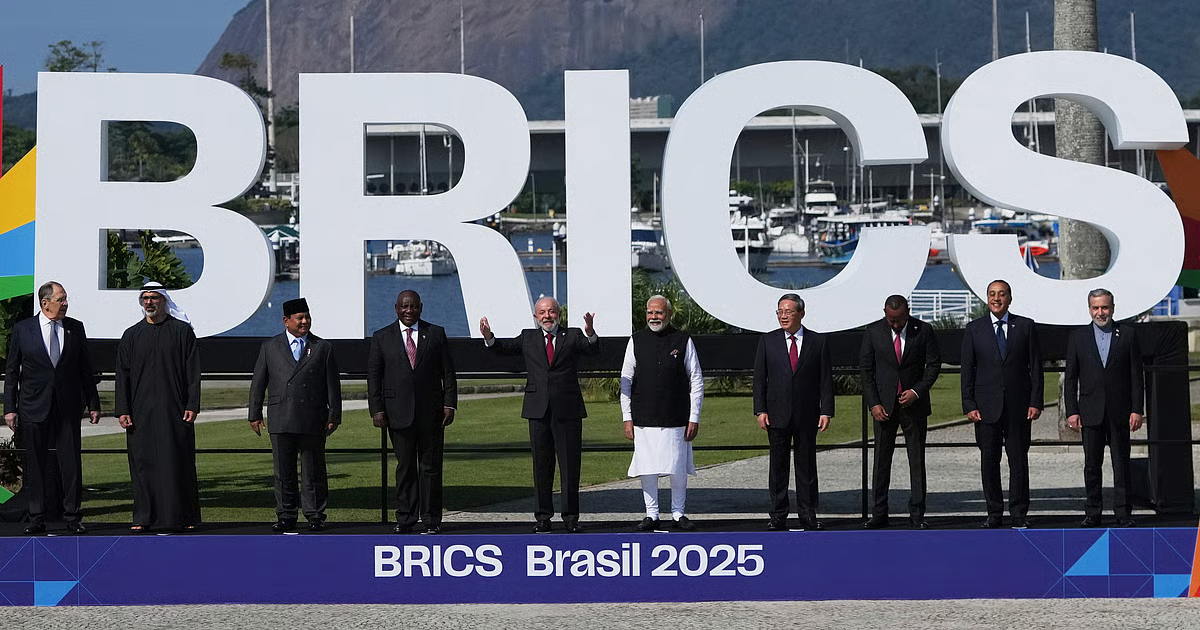
India assumed the BRICS presidency on 1 January 2026 under the theme "Building for Resilience, Innovation, Cooperation and Sustainability", inheriting a grouping that has changed considerably from the forum of five founding states it had last chaired in 2021. The 2024 Kazan summit formalised the accession of Egypt, Ethiopia, Iran and the UAE, while Indonesia joined in January 2025, bringing the full membership count to eleven. A further ten countries, including Belarus, Bolivia, Kazakhstan, Malaysia, and Nigeria, were designated as partner states.
The expanded BRICS now accounts for roughly 41 percent of global GDP by purchasing power parity and nearly half the world's population. The scale of this transformation has elevated the stakes of each presidential cycle, and India's chairmanship arrives at a moment when the bloc's institutional character is actively being contested internally and externally.
From within, fault lines have deepened over the pace and criteria of expansion, governance reform of the New Development Bank (NDB), and the normative framing of development finance. The bloc's much-vaunted consensus model is straining under the weight of fourteen member-states with divergent interests and asymmetric leverage. The recent U.S.-Israel confrontation with Iran has further raised questions about the role multilateral groupings such as BRICS should be playing during major geopolitical crises.
On the other hand, Washington's framing of BRICS as an implicitly anti-Western coalition, backed by trade pressure and political warnings, has added external pressures on New Delhi’s chairmanship. For New Delhi, the presidency also comes at a time when a cautious bilateral stabilisation is taking shape with Beijing. During Chinese Foreign Minister Wang Yi's visit in August 2025, among the several steps the two sides took toward re-engagement was a mutual pledge to support each other's forthcoming BRICS presidencies, with China endorsing India's 2026 hosting and India reciprocating for China's 2027 chairmanship. The visit also led to the twenty-fourth round of Special Representatives' talks on the boundary question post which the joint outcome document outlined plans to resume dialogue mechanisms, framed in the language of "forward-looking discussions". That the two sides could agree on this much, against the backdrop of unresolved border tensions and an adversarial bilateral dynamic since Galwan in 2020, carries some diplomatic significance. However, the gesture should be read as a floor-level commitment, not a ceiling. It reflects a narrow, institutionally defined convergence, not any durable alignment of strategic intent.
Table I: BRICS Membership Expansion
|
Member / Status |
Key Fact |
Backed By |
Strategic Importance |
|
Egypt |
Joined Jan 2024. Largest Arab economy by PPP; 1 Suez Canal controls considerable global trade. |
China, Russia |
Extends BRICS geographic reach into North Africa and Arab world; reduces US leverage over Egypt's debt-dependent economy. |
|
Iran |
Joined Jan 2024. Under active US sanctions at time of accession. |
China, Russia |
Signals BRICS willingness to absorb sanctioned states; gives Beijing and Moscow an institutional buffer. India abstained from explicit enthusiasm given its own US partnerships. |
|
UAE |
Joined Jan 2024. Major global financial hub; extensive US defence ties. |
Consensus |
Signals that BRICS is not ideologically anti-Western. UAE's inclusion partly to balance Iran's entry and reassure India and the Gulf of bloc. |
|
Ethiopia |
Joined Jan 2024. Largest economy in East Africa by PPP.2 |
China, Russia |
Deepens BRICS's African footprint. China holds a considerable amount of Ethiopian infrastructure debt, giving Beijing structural influence over Addis Ababa's positioning. |
|
Indonesia |
Joined Jan 2025. World's 4th most populous state; 3 G20 member. |
Consensus |
Most geopolitically significant 2025 entrant. India supported inclusion as it diversifies bloc beyond China-aligned states. Jakarta's strategic autonomy doctrine mirrors New Delhi's. |
|
Pakistan (rejected) |
Applied Aug 2023. Not admitted at Kazan 2024; not designated partner state. |
China, Russia |
India's non-consensus was decisive. Pakistan's exclusion is the clearest single instance of India constraining Chinese expansion ambitions within BRICS. |
|
Partner States (13) |
Designated at Kazan 2024 and Rio 2025: Belarus, Bolivia, Cuba, Indonesia (since full member), Kazakhstan, Malaysia, Nigeria, Thailand, Uganda, Uzbekistan, Vietnam, among others.4 |
Mixed |
Partner status carries no decision-making rights. Serves as a waiting category that allows expansion optics without conferring institutional power on China-aligned or contested states. |
Sources: 1World Bank Open Data (Egypt); 2World Bank Open Data (Ethiopia); 3Worldometer; 4BRICS ; author’s assessment
What Each Side Wants from BRICS
China's strategic interest in BRICS has evolved markedly since the group's formation. In its original configuration, BRICS served primarily as a platform for articulating dissatisfaction with the dollar-centric financial order and pressing for reform of Western-dominated institutions. For Beijing, those objectives remain relevant, but the 2023 and 2024 expansion rounds have given BRICS an additional function of acting as a vehicle which is demonstrating the geographic and political reach of a Chinese-led counter-institutional order. Beijing's state media has consistently framed the enlarged grouping as evidence that the Global South is asserting itself against Western-led institutions, and senior Chinese officials have situated BRICS alongside the BRI and the SCO as components of a coherent multilateral architecture.
India's calculus, however, is fundamentally different. For New Delhi, BRICS remains one of the few multilateral platforms where it can engage Beijing on an equal institutional footing rather than within a China-led architecture. Equally, it provides a platform for engaging the Global South on India's own terms, distinct from both the Western-led institutional order and the China-centric alternative. India's continued presence in BRICS, as many have argued, is in part a function of not wanting to leave a vacuum for China to exploit, where a withdrawal would invariably cede agenda-setting powers to Beijing without constraint. Active membership, even where it requires managing internal friction, preserves India's ability to moderate the grouping's trajectory.
The Expansion Fault Line
The sharpest and most visible site of India-China divergence within BRICS has been the question of membership expansion, and specifically the candidacy of Pakistan. Islamabad formally applied for BRICS membership in August 2023, and both China and Russia have signalled support for its accession. Russian Deputy Prime Minister Alexei Overchuk, during a visit to Islamabad in September 2024, publicly declared Moscow's backing for Pakistan's entry. China's position has been consistent with its broader framing of BRICS expansion as an expression of Global South inclusivity. India's response on the other end has been equally firm. At the Kazan summit in October 2024, Prime Minister Modi stated explicitly that all expansion decisions must be taken by consensus and that the criteria established at the 2023 Johannesburg summit, including the requirement that new members maintain diplomatic and friendly relations with all existing members, should be rigorously observed. Pakistan hence was not admitted nor was it designated as a partner state.
India's resistance to Pakistan's entry was not primarily about bilateral hostility, though that is clearly a factor. It reflects a strategic calculation about the direction of the grouping where Pakistan's accession, particularly if sponsored by a China-Russia axis within BRICS, would further consolidate Beijing's position and weaken India's standing. This is not merely about blocking a rival but also about preserving the political trajectory that allows India to function as an autonomous actor rather than a minority voice. The fact that BRICS operates by consensus gives India an effective veto and New Delhi is likely to pursue this aspect as a matter of principle rather than an exception. Nonetheless, Pakistan's membership question is likely to resurface under China's 2027 chairmanship, when Beijing will have considerable influence over the expansion agenda and the framing of the discussion.
The broader expansion dynamic also reveals something about how the two countries approach institutional design. China has favoured rapid expansion, seeing a larger membership as a sign of the grouping's global legitimacy and as a means of diluting the relative weight of any single member who might resist its preferences. India has favoured consolidation and criteria-based admission, seeing a tightly governed expansion as essential to preserving the bloc's internal coherence and, implicitly, its own influence within it. The creation of the "partner country" category at Kazan represented a partial compromise, allowing the grouping to signal openness without conferring full decision-making rights on new entrants. But it did not resolve the underlying disagreement about how much further, and how fast, BRICS should grow.
The NDB and the Contest Over Financial Architecture
The New Development Bank, established in 2015 with equal voting shares distributed among the five founding members, was designed to offer an alternative development finance model — sovereign-equal governance, no Western-style policy conditionality, and, in principle, a greater orientation toward local currency financing. Each founding member holds approximately a 20 percent share, and the founding five will always retain at least 55 percent of voting rights regardless of future membership expansion. This structural equality was intended as a statement of principle; however, in practice, it has become a site of institutional contestation.
China's ambition for the NDB has been consistently larger than what the bank has delivered. Beijing has sought to use the NDB as a vehicle to support its BRI-related infrastructure but ran into resistance from New Delhi when it attempted to get the bank to support BRI-related work. The NDB's governance norm of decision by greater agreement, if not consensus, has meant that these Indian objections carry institutional weight, limiting the bank's expansion into China’s preferred territory.
On local currency lending, the NDB's stated target is to make 30 percent of its loans in local currencies from 2022 to 2026, and it has issued bonds denominated in renminbi and South African rand. The NDB plans its first rupee-denominated bond in the Indian domestic market by the end-March 2026 and is in advanced discussions with the Reserve Bank of India (RBI) for that debut issuance. India's approach to this mechanism reflects its wider position on de-dollarisation, which is both cautious and selective. New Delhi has permitted bilateral local currency settlement with select partners, including the UAE and Indonesia, and the RBI has permitted Vostro accounts, which would enable foreign entities to settle trades directly in Indian Rupees with BRICS members. But Indian and South African officials have explicitly stated that there is no agenda to create a BRICS currency, nor to replace the dollar's role in global finance.
China's position, on the other hand, has been considerably more aggressive. Beijing's Cross-Border Interbank Payment System (CIPS) had 1,467 indirect participants across 119 countries as of January 2025, linking banks in 185 countries. The October 2024 Kazan summit also ended up discussing the development of a BRICS Pay decentralised payment messaging system aimed at facilitating transactions in local currencies, which is sure to cause troubles for the SWIFT network.
Russia and China have driven the de-dollarisation agenda with urgency, reflecting the direct impact of sanctions on their own financial systems. India's exposure to that sanction risk is fundamentally different, and its institutional partnerships with the United States and Europe has created incentives to avoid overcommitting to alternative payment architectures in which China holds structural advantages. The result has been a BRICS financial architecture that is institutionally in motion but internally divided about its direction.
Table II: India-China Institutional Positions Across BRICS
|
Dimension |
India's Position |
China's Position |
|
BRICS Membership Expansion |
Consensus-based, criteria-driven. Supports expansion only where new members hold friendly relations with all existing members. Restricted Pakistan's accession at Kazan 2024. |
Favours rapid expansion as a signal of Global South legitimacy. Backed Pakistan, Algeria and Turkey candidacies. Sees a larger bloc as diluting any single veto-wielding member. |
|
New Development Bank (NDB) |
Resists BRI-linked project financing through the NDB. Advocates sovereign-risk-based assessment and borrower autonomy. Cautious about renminbi-denominated lending dominance. |
Sought to channel BRI-adjacent infrastructure through the NDB. Holds 20% founding share but has pushed for a broader mandate aligned with Chinese connectivity priorities. |
|
De-dollarisation / Payment Systems |
Selective and cautious. Permits local currency bilateral settlement (UAE, Indonesia). Explicitly opposes a BRICS currency and avoids committing to BRICS Pay architecture where China holds structural advantages. |
Aggressive. CIPS system links 1,467 indirect participants across 185 countries. Championed BRICS Pay decentralised messaging at Kazan 2024. Uses renminbi internationalisation as a strategic instrument. |
Author's assessment based on sources cited
India's Presidency and the Institutional Contest Ahead
India's 2026 chairmanship is framed around four pillars: resilience, innovation, cooperation and sustainability. External Affairs Minister Jaishankar's launch of the presidency emphasised a "Humanity First and People-centric" approach and explicitly positioned BRICS as non-Western rather than anti-Western, a distinction India has consistently tried to maintain against the more confrontational instincts of Russia and China. The practical agenda includes the promotion of India's Digital Public Infrastructure model as a scalable development framework, AI governance, and an emphasis on criteria-based institutional reform including at the IMF, World Bank and the UN. These are not only programmatic and rhetorical framings but are important and implicit arguments about what kind of multilateral actor BRICS should be.
The chairmanship gives India real, if time-limited, agenda-setting authority. As the presiding state, it controls the framing of ministerial discussions, the priority areas of the over 100 planned meetings across the presidency, and ultimately the political tone of the summit declaration later in the year. India has previously used its BRICS presidencies to embed counter-terrorism language in summit texts that has constrained China's ability to simply align itself with Pakistan's positions. That assertiveness however has not been evenly applied; India's near-silence on the Iran crisis, now a full member of the grouping, points to a broader unresolved question about where the BRICS is heading. It therefore remains to be seen whether India's presidency will steer BRICS toward consolidation as a more structured, rules-oriented multilateral forum, or whether the grouping will gradually drift into a looser coalition united more by shared dissatisfaction with existing global institutions than by a coherent strategic agenda.
Following New Delhi’s presidency, Beijing will have observed how India exercises the presidency and will orient its own priorities accordingly when it takes over the same in 2027. The Pakistan membership question is likely to return under China's chairmanship with renewed momentum, as will the de-dollarisation and BRICS Pay agendas that India has approached with deliberate caution. How India uses the 2026 chairmanship, on NDB governance reform, expansion criteria, the normative framing of development finance, or even the moderation of the West's overreach, will ultimately determine if this presidency is remembered as a substantive one.
Image Credit: AP
Author
Ratish Mehta
Ratish Mehta is a Senior Research Associate at ORCA. He is the co-editor of the Special Issue on India’s Soft Power Diplomacy in South Asia and serves as the co-lead for the project ‘The Episodes of India-China Exchanges: Modern Bridges and Resonant Connections’, which is rooted in the desire to enhance public consciousness of cross-cultural contributions of both societies. Ratish’s area of interest includes understanding the value of Narratives, Rhetoric and Ideology in State and Non-State interactions, deconstructing political narratives in Global Affairs as well as focusing on India’s Foreign Policy interests in the Global South and South Asia. He was previously associated with The Pranab Mukherjee Foundation and has worked on projects such as Indo-Sino relations, History of the Constituent Assembly of India and the Evolution of its Democratic Institutions. He is also the co-convenor of ORCA's Global Conference on New Sinology (GCNS), which is India's premier dialogue driven China conference. He is an alumnus of Ambedkar University, Delhi.