
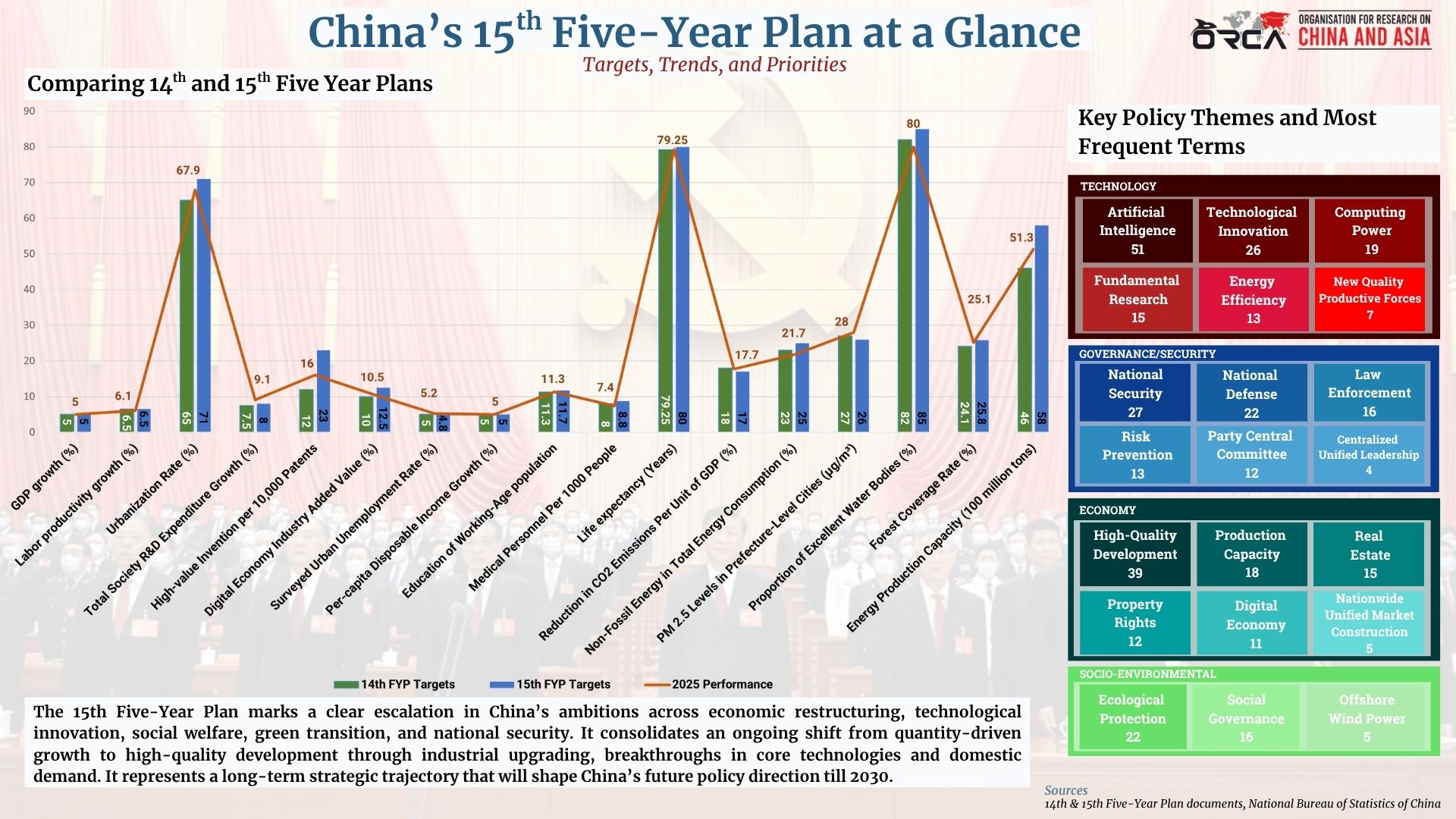

China’s 15th Five-Year Plan reflects a calibrated shift towards high-quality development, where growth is increasingly balanced with innovation, sustainability, and security priorities. While traditional metrics such as GDP growth and urbanisation remain central, 2025 performance levels suggest that China is already nearing several intermediate targets, particularly in infrastructure, emissions intensity, and industrial capacity, enabling more ambitious future projections. The Plan places stronger emphasis on technological self-reliance, energy efficiency, and environmental outcomes, marking a transition from scale-driven expansion to productivity-led growth. Compared to the previous cycle, ambitions have risen in areas such as life expectancy, clean energy adoption, and advanced manufacturing, even as progress in some social indicators remains gradual. The key challenge lies in closing the gap between current performance and long-term objectives amid demographic constraints and regional disparities. As governance and security concerns gain prominence, the Plan reflects a more integrated development model where resilience and sustainability are as critical as economic growth.
Prepared by
Afridi Ahmed
Afridi Ahmed is a Research and Administrative Intern at Organisation for Research on China and Asia (ORCA). He is a postgraduate in Conflict Analysis and Peacebuilding from Jamia Millia Islamia, New Delhi. He has previously interned with the Council for Strategic and Defense Research (CSDR), a New Delhi-based think tank. His research interests include strategic studies, Indo-Pacific security, China's strategic behaviour, and maritime geopolitics, with a particular focus on South and Southeast Asia.