
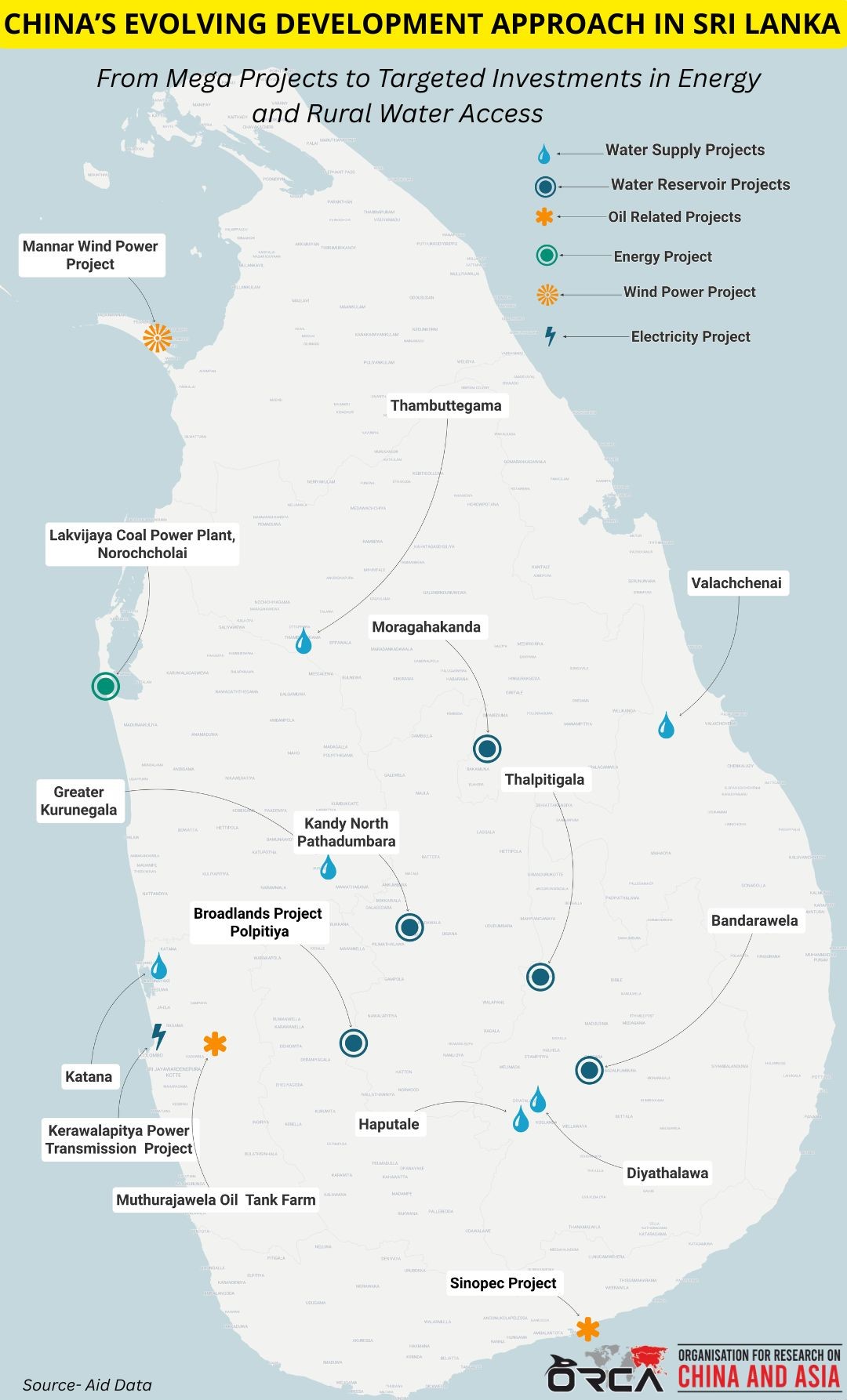
Click here to view the full map. 
China’s evolving approach to development engagement in Sri Lanka combines mega-projects like oil refineries with “small and beautiful” initiatives like water supply projects for rural and township communities. The shift can be attributed to a number of factors. Following criticisms of a “debt trap”, Beijing has responded to narratives eroding the impact of Belt and Road Initiative (BRI) projects. The shift towards smaller-scale projects is also driven by domestic economic pressures like local government debt and overseas corruption by Chinese enterprises. Moreover, according to Aid Data estimates, 80% of China's overseas lending portfolio in the developing countries was focused on supporting countries in financial distress. Reducing such financial risks has also been a focus of the BRI’s evolution.
In Sri Lanka, projects relating to water supply and electricity generation have a more people-centric impact, where water shortages and electricity cuts are recurring issues. For instance, electricity tariff hikes are a recurring issue. Electricity tariffs were hiked by 11.5% in January 2026, and the increase was justified based on the distress within the Sri Lankan economy. Similarly, Sri Lanka's water scarcity issue is multifaceted and recurring. Several studies have shown that apart from physical scarcity of water, poor water management practices contribute to scarcity. Chinese investments in such sectors leverage the impact of development projects for positive public perceptions and local goodwill. Targeting these sources of local distress with development finance projects generates community-level goodwill and positive perceptions of China.
Although China has shifted its focus to smaller-scale, people-centric investments in Sri Lanka, it has not abandoned its capital-heavy, connectivity infrastructure-centric projects that generate goodwill with political elites. Sri Lankan leadership's emphasis on energy security has been met with Chinese interest in the provision of large-scale energy infrastructure. President Anura Kumara Dissanayake, following his state visit to China in January 2024, secured the Sinopec Oil Refinery Project. The Sinopec Oil Refinery Project is a 3.7 billion USD investment push towards energy security, an attempt to diversify energy sources and address a critical shortcoming in Sri Lanka’s development policy framework.
Author
Rituja Ghosh
Rituja Ghosh is a Research and Administrative Intern at Organisation for Research on China and Asia (ORCA). She holds a master's in International Relations from South Asian University, New Delhi. She has presented her work in several prestigious conferences, such as the paper titled "Sinicization in the People's Republic of China: An Analysis of Language Policies" at the 16th All India Conference on China Studies. She has previously worked as a Security Analyst with a corporate firm and as an Academic Associate at the Kautilya School of Public Policy, Hyderabad. Her interests lie in studying the politics of South Asia, India-China relations and China’s social and cultural policies.