
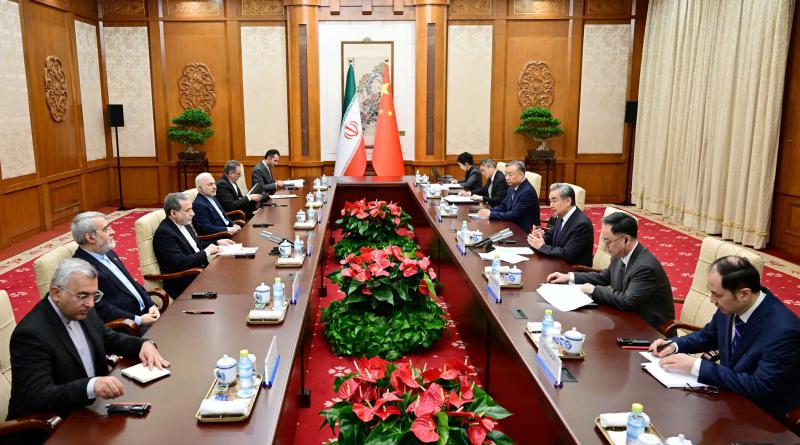
China’s Special Envoys to the Middle East, Africa and Horn of Africa are projecting a common strategic message to regional capitals; China has a lasting place in the security and economic architectures of these regions. The announcement on 2nd November by China’s Foreign ministry that special envoys will travel to their respective regions was well-timed and coordinated - on the same day, the Omani Sultan made a historic, first visit to China since diplomatic ties were established and Wang Yi met with senior national security officials from Iran and Saudi Arabia in Beijing. The Foreign Ministry’s announcement has been followed up with an acceleration of diplomatic activity - Zhai Jun (Special Envoy for the Middle East) met officials in Tehran, Liu Xianfa (Special Envoy for Africa) called on the Ethiopian Foreign Minister and Hu Changchun (Special Envoy for Horn of Africa) met Eritrea’s President.
With the US midterm elections and Israel’s parliamentary elections expected to shift bargaining positions of conflicting parties, and perhaps produce a political resolution to the conflict with Iran, Beijing has sent its Envoys to opportunistically position China as a key peace-broker. At its core, China remains invested in facilitating a resolution to conflict, securing its economic interests and projecting the image of a responsive and responsible actor in the region. The surge in shuttle diplomacy is not a departure from the limited, mediator role Beijing is comfortable with. It is only a mechanism to ensure strategic balance in China’s relationships and project Beijing as a reliable intermediary with an interest in stability.
Anticipation of Emerging Shifts
Visits to regional capitals are an opportunistically-timed effort to engage regional stakeholders, just as the United States and Israel recalibrate their diplomatic outreach after major shifts in internal political outcomes. Beijing expects that the election outcomes in the US and Israel exert greater pressure to find an end to the conflict or at least force reconsiderations of current positions. There is also the possibility that an internal struggle within the US Republican Party creates uncertainty and paralysis in policy. Either scenario is an opening for China to reinforce its role as a reliable intermediary urging dialogue. Wang Yi’s remarks to the Saudi Deputy National Security Advisor that, “the region was once again at a critical juncture between war and peace” suggest that China sees this interim period as an opportunity.
At the same time, shuttle diplomacy has become a medium to embed China’s contributions within a potential, future settlement. By reiterating China-led proposals, the Special Envoys echo China’s concern of being left out of any negotiated outcome to the Iran-US-Israel conflict. High-frequency consultations between Beijing and regional stakeholders like Iran and Saudi Arabia don’t just fix Chinese interests within the horizon of any emergent political process, they also sustain momentum of a peace-broker process China is keen to take credit for. Consequently, mandates given to the Special Envoys, of advancing initiatives proposed by Xi Jinping, such as the “Outlook on Peace and Development in the Horn of Africa” and the “Four Point Proposal on Promoting Peace and Stability in the Middle East”, are a signal that China’s contributions to the process matter as much as retaining influence on the outcome.
Let’s not forget that there are significant economic and energy interests at stake for China. Beijing is acting swiftly, anticipating shifts and recalibrations, to protect its vast, interconnected complex of interests. The coordinated visits of Special Envoys cover a single interconnected corridor from the Persian Gulf and Red Sea to the Horn of Africa, a region that carriers the bulk of Chinese energy imports, with massive economic security implications for China as it enters the 15th Five-Year Plan period. China sees these regions as interconnected, and a flashpoint or spillover effect in one part of the region leaves trade and energy flows vulnerable for all others. As a result, Zhai Jun’s meeting in Tehran included an appraisal of the situation in Yemen, which has demonstrated the potential to be far more damaging than expected by Riyadh. Besides the immediate interests and signals coded into China’s foreign policy behavior, the latest round of shuttle diplomacy is an opportunity to reflect on how it dovetails with broader foreign policy intents.
Principles in Practice
Beijing’s direct economic interests in the Middle East are discernable, and explain the direction of diplomatic engagement. There is also a broader, more indirect set of interests driving Beijing’s shuttle diplomacy. First, China is developing the role of a credible intermediary - a mediator, who is capable of facilitating dialogue by offering its good offices. Two objectives are achieved through this. First, China builds credibility in sub-regions around the world by offering the global public good of mediation and second, good relations with all parties are maintained, which ensures strategic balance of relations for China. But can China compel conflicting parties to accept the status-quo or make concessions where necessary? Beijing does not define its role as such, and may not be keen to expend political capital to produce a face-saving outcome for the US.
In fact, so much of China’s role definition as a responsible, non-interventionist and reliable actor on the global stage is presented in contrast to the US. Much like the swing in US elections, US President Donald Trump’s shifting position on the Iran conflict has given Beijing the opportunity to strike the right tone in its strategic communication. Projecting a reliable and non-interventionist image in contrast to the US as unreliable and inconsistent partner is a major aspect of its messaging to the Global South. At the same time, China has flagged the volatility and uncertainty of its external environment and the challenges that are created for policy planning and domestic economic development. Beijing is keen to be seen as mitigating these external shocks, by engaging conflicting parties, for its own domestic political and economic audience.
What Next?
Shuttle diplomacy in the Middle East and Africa dovetails with a variety of China’s global initiatives and multilateral engagements. Mediation in the Middle-East and Africa advance the Global Security Initiative by enmeshing the language and China-sponsored principles of security within the normative and institutional conduct of the region. China is also the chair of BRICS in 2027, and securing a joint statement or consensus will be difficult to say the least, as evidenced by New Delhi’s mammoth effort to secure a joint statement at the BRICS Summit in 2026. In this respect, one explanation for the shuttle diplomacy is that China is laying the groundwork for securing favorable outcomes at the BRICS 2027 Summit.
Ultimately, China's expectation from the latest round of shuttle diplomacy is risk reduction: preventing further escalation and protecting the interconnected economic and energy interests it has accumulated across the region. Most importantly, Beijing will seek reciprocity from regional partners, including greater receptiveness to its diplomatic initiatives, support for its preferred principles of regional security and alignment on core national interests. China's method is focused on cultivating reciprocal relationships and ensuring that its interests are accommodated in any emerging regional order. The message is clear: Beijing intends to remain invested, engaged and influential.
Image Credit: The Arab Weekly
Author
Rahul Karan Reddy
Rahul Karan Reddy is Senior Research Associate at Organisation for Research on China and Asia (ORCA). He works on domestic Chinese politics and trade, producing data-driven research in the form of reports, dashboards and digital media. He is the author of ‘Islands on the Rocks’, a monograph on the Senkaku/Diaoyu island dispute between China and Japan. He is the creator of the India-China Trade dashboard, the Chinese Provincial Development Indicators dashboard and co-lead for the project ‘Episodes of India-China Exchanges: Modern Bridges and Resonant Connections’. He is co-convenor of ORCA’s annual conference, the Global Conference on New Sinology (GCNS) and co-editor of ORCA’s daily newsletter, Conversations in Chinese Media (CiCM). He was previously a Research Analyst at the Chennai Center for China Studies (C3S), working on China’s foreign policy and domestic politics. His work has been published in The Diplomat, 9 Dash Line, East Asia Forum, ISDP & Tokyo Review, among others. He is also the Director of ORCA Consultancy.