
Last month, a new wave of Sinicization in Ta’ang- and Shan-majority territories, where local languages, educational institutions, and cultural symbols are being replaced or subordinated by Chinese linguistic and administrative practices under the control of the Myanmar National Democratic Alliance Army (MNDAA). The Sino-Myanmar borderlands, particularly across northern Shan and Kachin States, are home to diverse ethnic communities, including the Shan, Ta’ang, Kachin, Wa, and Kokang Chinese, that exercise varying degrees of autonomous control. In traditionally ethnic Chinese-majority regions such as Kokang (descendants of Han Chinese) and the Wa Self-Administered Division, Chinese language, currency, and administrative practices have long dominated everyday life due to deep-rooted political and economic dependence on China. However, the transformation currently unfolding in northern Shan State suggests that what was once largely limited to a few townships is now evolving into a broader Chinese-dominated political and cultural space across northern Myanmar.
The broader significance of this transformation lies not only in its implications for Myanmar’s sovereignty and ethnic politics, but also in what it reveals about the changing nature of Chinese regional influence. Much like China’s domestic Sinicization policies in frontier regions such as Xinjiang and Tibet, where language, education, economic integration and administrative restructuring have been used to consolidate state authority, the developments in northern Shan suggest continuity in Beijing’s broader frontier strategy. However, unlike Xinjiang and Tibet, where such policies are implemented directly by the Chinese state, the process in northern Myanmar appears to operate indirectly through ethnically aligned EAOs. This process signals a broader shift in China’s neighborhood diplomacy, where political fragmentation in neighboring states is increasingly leveraged to expand economic, cultural, and strategic influence along its periphery.
Language, Education and the Reengineering of Identity
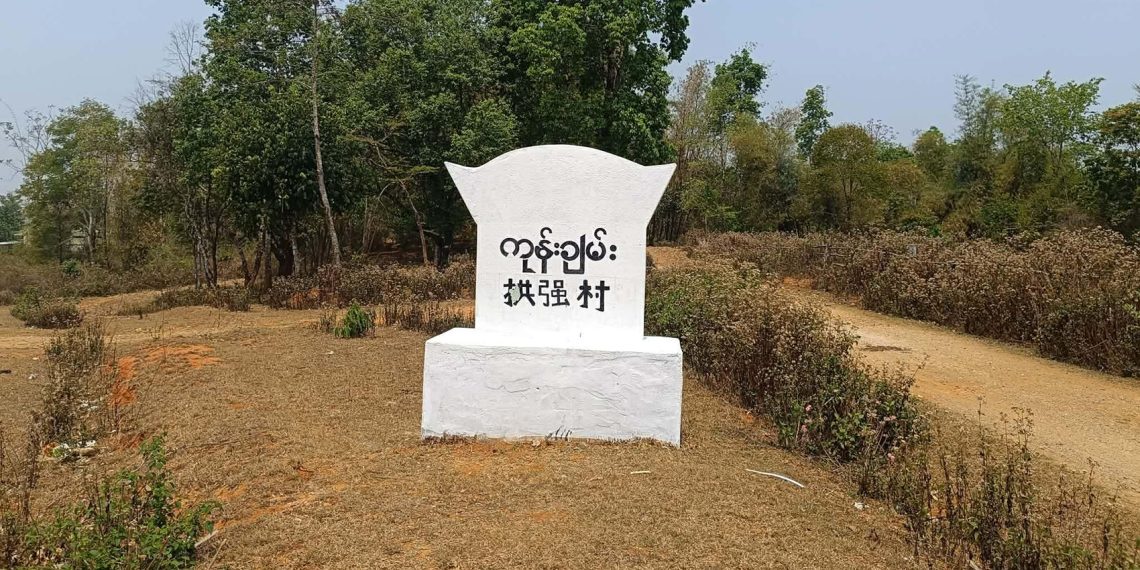
The Kokang region in Shan state has historically maintained close ethnic, linguistic, and commercial ties with China, but recent developments in northern Shan State underscore that this relationship is evolving into a broader process of political and institutional incorporation. Following Operation 1027, territories captured by MNDAA have increasingly exhibited characteristics of what may be described as an emerging Sinophone frontier order. In these regions, governance practices, public administration and symbolic authority are being reorganized around Chinese linguistic and administrative norms. For instance, Chinese language signage has replaced indigenous scripts and Chinese administrative norms are becoming institutionalized. This is particularly visible in Kutkai Township, where the MNDAA reportedly erased Ta’ang-language village signs and replaced them with Chinese and Burmese text in more than a dozen villages. Significantly, these measures were implemented without consultation with village committees or local representative bodies, highlighting how MNDAA are increasingly superseding indigenous governance structures while simultaneously institutionalizing Chinese-oriented administrative practices.
Moreover, language has become one of the most visible instruments through which authority is being asserted in northern Shan State. The replacement of local languages with Chinese in public spaces represents a redefinition of political and cultural belonging. Since April 2025, the MNDAA has reportedly banned Shan- and English-only signage in areas under its control, requiring businesses to use Chinese as the primary language. In towns such as Hseni, Chinese characters now dominate commercial spaces, government notices, and local administration. The issue is therefore not simply the adoption of Mandarin for pragmatic economic reasons, but the gradual restructuring of public space and political authority in ways that marginalize local ethnic identities.
The education sector demonstrates this transition even more clearly. Reports indicate that more than 300 schools operated by the Ta’ang Land Education Council were suspended by the MNDAA, while compulsory Mandarin-language education is being introduced in newly controlled territories. Previously, Mandarin education in northern Shan was largely driven by economic pragmatism, with many local communities voluntarily seeking Chinese-language proficiency to access employment opportunities, trade networks, and mobility connected to Yunnan Province. However, the growing institutionalization of Mandarin in areas governed by MNDAA marks a shift from voluntary adaptation to forceful integration. This process mirrors developments in the United Wa State Army (UWSA)-controlled Wa region, where Mandarin functions as the working language and Chinese systems dominate administration and commerce. While Chinese-language education undoubtedly provides economic opportunities, its compulsory incorporation into governance structures simultaneously accelerates the gradual integration of these territories into China’s economic and cultural orbit. While Chinese-language education undoubtedly provides economic opportunities, its compulsory incorporation into local governance accelerates the integration of these territories into China’s economic and cultural orbit while further weakening Myanmar’s central authority in the borderlands.
Economic Incentives and the Political Logic of Indirect Sinicization
For ethnic armed groups such as MNDAA, the adoption of Chinese linguistic, administrative, and economic practices serves a strategic function tied to political survival, territorial consolidation, and economic extraction. Indirect Sinicization, therefore, operates as a mutually beneficial arrangement between Beijing and borderland non-state actors. For Beijing, stability along the Yunnan frontier is critical for safeguarding trade routes, protecting infrastructure investments, suppressing cross-border instability, and ensuring uninterrupted access to strategic resources. Rather than imposing direct territorial control, Beijing has increasingly relied on EAOs to regulate commercially significant border zones and maintain order in areas where Chinese economic and strategic interests are concentrated. This allows China to expand its economic and strategic influence across northern Myanmar without bearing the political and military costs associated with formal intervention.
A closer relationship with China provides the EAOs with substantial political and economic advantages. Armed groups such as the MNDAA now control key trade routes, including the strategically important Chinshwehaw corridor, enabling them to generate revenue through taxation and cross-border commercial flows. Control over trade routes, estimated to be worth nearly USD 9 billion annually, marks a major geopolitical shift, strengthening China’s economic influence while simultaneously altering the balance of power away from the military junta. As Chinese goods, traders, and vehicles increasingly dominate these routes, the widespread circulation of the yuan has further integrated local economies into China’s commercial sphere while insulating border territories from Myanmar’s collapsing national economy. At the same time, Chinese-backed agribusiness and commercial investments have accelerated the economic incorporation of northern Shan into China’s provincial economy. Large-scale banana, sugarcane, watermelon, and pineapple plantations linked to Chinese private investors have transformed local land-use patterns, generating concerns over land dispossession, environmental degradation and demographic shifts. In areas such as Hseni, residents have also reported a visible increase in Chinese migration and business ownership, reinforcing fears that economic integration is producing long-term external structural dependency rather than local development.
These economic transformations simultaneously strengthen the autonomy of borderland EAOs. Revenues from Chinese private enterprises, informal trade networks, taxation systems, and rare earth extraction activities provide them with critical financial resources to sustain governance and military operations. In exchange for maintaining stability and safeguarding Chinese commercial interests, these organizations reportedly receive varying forms of defense assistance, economic patronage from Chinese-backed economic networks, political backing to a certain extent, and access to cross-border markets. Consequently, many EAOs increasingly function as proxy non-state actors managing China’s economic and strategic interests along the frontier.
Eroding Frontier Sovereignty?
Beyond the changing socio-political and economic landscape, this evolving relationship has also begun to fundamentally reshape sovereignty along the Sino-Myanmar frontier. As local populations become increasingly dependent on Chinese currency, markets, employers, infrastructure, and educational systems, the influence of Naypyitaw continues to erode, further weakening an already fragile state authority in northern Shan State. Recent reports of Chinese border fencing extending deeper into Myanmar territory further reinforce perceptions of creeping territorial encroachment. Villagers along the Shan-Yunnan border have described agricultural land divided by newly erected fences and streams abruptly reclassified as lying on the “Chinese side”. While Myanmar authorities had previously responded to similar incidents through diplomatic protests, both the state and non-state actors now appear increasingly reluctant to challenge Chinese incursions.
Hence, by maintaining parallel relationships with both the Tatmadaw and borderland EAOs, China has been able to preserve strategic leverage regardless of shifts in Myanmar’s domestic political landscape. This also shows that China has increasingly leveraged Myanmar’s weakened state authority to expand its influence through economically dependent and politically aligned non-state actors operating along the frontier. In doing so, instability in Myanmar has created opportunities for Beijing to deepen cross-border economic integration, secure strategic trade corridors, protect infrastructure investments, and consolidate influence over territories lying beyond Naypyitaw’s effective control. Consequently, Northern Shan State illustrates a contemporary form of geopolitical influence in which sovereignty is not overtly dismantled through direct annexation, but gradually reconfigured through economic dependency and proxy governance. What is unfolding along the Sino-Myanmar frontier is not a conventional territorial expansion, but the consolidation of a quasi-Sinophone buffer zone sustained through politically aligned EAOs and cross-border economic integration.
Image Credit: The Irrawaddy
Author
Ophelia Yumlembam
Ophelia Yumlembam is a Research Associate at the Organisation for Research on China and Asia (ORCA). Before joining ORCA, she worked at the Dept. Of Political Science, University of Delhi, and interned at the Council for Strategic and Defence Research in New Delhi. She graduated with an M.A. in Political Science from the DU in 2023. Ophelia focuses on security and strategic-related developments in Myanmar, India's Act East Policy, India-Myanmar relations, and drugs and arms trafficking in India’s North Eastern Region. Her writings have been featured in the Diplomat, South Asian Voices (Stimson Centre), 9dashline, Observer Research Foundation, among other platforms.