
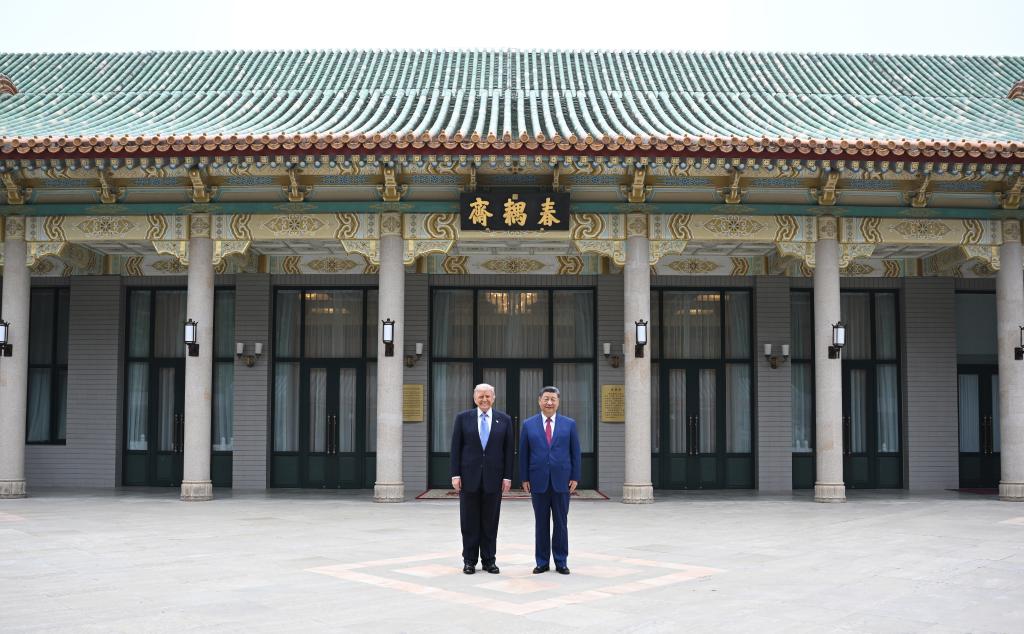
The China-US trade war, which began in 2018, entered a new phase with the meeting between President Xi Jinping and President Donald Trump on 30th October, 2025. The two leaders discussed economic and trade issues and reached a consensus on easing some of the tensions between the countries. While President Trump presented the outcome as a victory for the United States, the agreement may point to a deeper shift in the balance of economic power towards China, with implications extending well beyond the two countries, particularly for the Global South. The trade war reached another milestone when Xi and Trump met from 14th to 15th May this year to discuss agricultural trade, including soybean exports, the reduction of trade barriers, and the renegotiation of their earlier trade truce. On 24th September, the two leaders reconvened to reinforce their economic agreements and explore future cooperation on AI.
This marked a significant turn in a conflict that originally began when the world’s two largest economies imposed successive rounds of import tariffs, escalating into a full-scale trade war. While those retaliatory actions created a “lose-lose situation” and widespread demands for de-escalation, the high-level meetings in October 2025, May 2026, and September 2026 signalled a deeper transformation. These talks demonstrated a shifting power dynamic, with China steadily gaining economic and geopolitical leverage over the US. Some of these shifts are reflected in the United States’ growing acknowledgement of its dependence on Chinese rare earth minerals, the establishment of a new US-China Board of Trade and Investment, Beijing’s dominance in renewable energy exports and its expanding influence in forums such as APEC and ASEAN.
Agreements Shaping Contemporary US-China Ties
Following their October 2025 talks, the two administrations projected distinctly different visions of success to the media. President Trump claimed that the agreements made during the meeting would safeguard US economic strength and national security, while President Xi maintained a more balanced view, emphasising the long-term benefits of cooperation rather than falling into “a vicious cycle of mutual retaliation”. However, despite these varied descriptions of the meeting’s implications, the US accepted its reliance on Beijing, given its need to access Chinese rare-earth minerals. Under the agreements reached at the October 2025 summit, China agreed to remove the rare-earth export controls it had imposed six months earlier, in April 2025. Western media sources suggest that Chinese export controls remain in force to safeguard domestic interests, pointing to a continuation of de facto restrictions despite the Xi–Trump agreement. Despite these underlying tensions, Beijing agreed to resume agricultural imports, specifically soybeans, sorghum, and cotton, reduce the flow of chemicals used in the production of fentanyl, to the US. In response, the US also agreed to remove the 10% cumulative tariff rate imposed on Chinese imports. This agreement to reduce tariffs, combined with Washington’s reliance on Beijing’s rare-earth minerals, can be interpreted as Trump “blinking first”, hinting at the potential shift in power from Washington to Beijing.
The meeting between the two leaders in May 2026 brought a renewed spirit of cooperation between the two countries. According to the White House, the “cornerstone” of the meeting was the establishment of the US-China Boards of Trade and Investment. While Washington sees this as a win due to its assurance of continued trade and US exports, Beijing’s presentation of the meeting hints at furthering long-term stability between the two countries. At their September 2026 meeting, the two sides also agreed on a US$30 billion tariff reduction framework and discussed US coal imports by China through further consultations under the board. This reliance on the board as a channel for ongoing dialogue reflects China’s long-term strategy to influence future US-China trade and investment cooperation. However, the stable relationship that China appears to seek may prove fragile amid a widening range of geopolitical tensions, including the fallout from the US-Iran war, threats to shipping in the Strait of Hormuz, and ongoing uncertainty over Washington’s stance on Taiwan.
China’s Strategic Alliances in Global Trade
Amid ongoing trade tensions, President Xi Jinping has actively sought to rebuild trust with key regional partners. A prime example is Chin’s move to host the 33rd APEC Economic Leaders’ Meeting in order to project Beijing’s “sense of responsibility as a major country”. This diplomatic push aligns directly with China’s broader strategy to deepen ties across Asia. On 28th October 2025, China and ASEAN already formalised a key pillar of this effort by updating their free trade relationship through the CAFTA 3.0 agreement. By prioritising digital trade, green growth, supply chain integration, and SME support, the upgraded framework promises smoother trade across the region.
CAFTA 3.0’s focus on the digital economy will boost Chinese exports despite US-sanctioned restrictions. Across nine updated and newly added sectors spanning green trade, supply chains, MSMEs, and streamlined customs procedures the agreement effectively lowers trade costs and speeds up customs clearance. These upgrades allow for an effective reduction of trade costs and improve customs clearance efficiency. This expanding economic integration is clearly reflected in trade figures, with China-ASEAN trade reaching an unprecedented $1.05 trillion in 2025 and continuing to rapidly expand, reaching $643 billion in the first half of 2026 alone. This integration can also be seen in China’s overall export growth, which is strongly driven by products like microchips, phones, and cars—all of which rely on complex value chains. In contrast, countries are now reluctant to align with the US due to the unpredictability of its tariff policies, and despite historically favouring the stability and value of the US market, this hesitation is prompting nations to shift towards China, handing Beijing an economic edge over Washington.
China’s Dominance in Renewable Exports
Beyond traditional commercial exchanges, the trade in renewable energy and fossil fuels represents another crucial area shaping this geopolitical shift. While the US’s total energy exports have continued to rise, most of these energy sources are non-renewable, whereas a relatively small percentage (25%) of the total energy exports include renewable sources such as natural gas. In contrast, China has been building solar panels, wind turbines and other renewables with a capacity exceeding 2.45 billion kilowatts, ranking first in the world. China’s export of renewable energy and sources of renewable energy reached an all-time high of $20 billion in 2025. This has prompted countries in the Global South to rely on China for renewables; solar panel exports to the Philippines nearly quadrupled, while shipments to the Democratic Republic of Congo grew sixteenfold. Such reliance on Chinese renewable sources export is especially relevant in light of the global supply shortages of oil and gas due to the disruptions underway at the Strait of Hormuz. This dynamic, coupled with fossil fuel subsidy reforms enforced by the World Trade Organisation (WTO) could further incentivise countries to shift towards renewables, making imports of renewable energy technologies and equipment from China an increasingly attractive alternative. As a result, Beijing holds a distinct advantage over Washington, whose share of global renewable energy production stands at just 9.18%. That gap is set to widen further as the Trump administration cuts funding across renewable energy and reprioritises domestic oil and gas development.
The subtle shifts in power, evident in Washington’s critical reliance on Chinese rare earths and Beijing’s long-term strategy surrounding the US-China Board of Trade and Investment these indicate a broader shift in economic and geopolitical power from the US to China. Beyond its bilateral relations with the US, China is proactively attempting to establish itself as a cornerstone of global trade. Through active engagement within APEC and the upgraded CAFTA 3.0 agreement, Beijing has reduced regional trade friction, accelerated export growth and embedded itself deeper into global supply chains. Additionally, China’s dominance in renewable energy manufacturing positions it to capture surging global demand, securing key overseas markets for green technology. Ultimately, by projecting institutional reliability, leveraging CAFTA 3.0 and monopolising the green energy transition, China places itself at a strategic advantage, preparing itself for a shift of economic and geopolitical power from the US.
Image Credit: Xinhua
Author
Avantika Anup
Avantika Anup is a fourth-year Undergraduate student at FLAME University, pursuing a major in Psychology and a minor in Economics. Her research interests lie in cross-cultural Psychology, AI and cognitive load, trade agreements, global value chains, and labour markets.